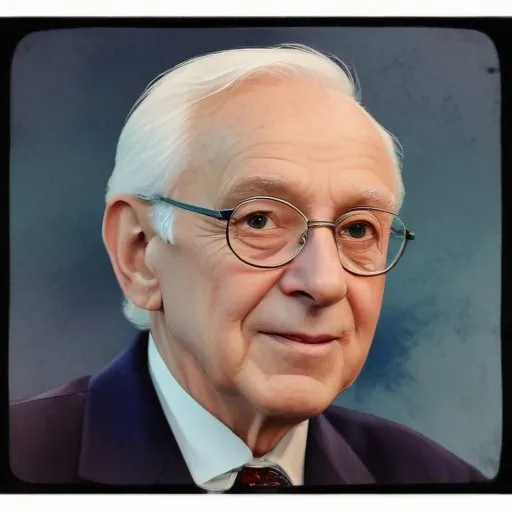
Unveiling the Pioneer of Neutrino Detection: Raymond Davis Jr.
A Chemistry Powerhouse and Nobel Laureate
Raymond Davis Jr., a trailblazing American chemist and physicist, revolutionized the field of particle physics by successfully detecting neutrinos emitted from the Sun. This groundbreaking accomplishment earned him the 2002 Nobel Prize in Physics, a testament to his unwavering dedication to the pursuit of scientific knowledge.
Early Life and Education
Born on October 14, 1914, in Washington, D.C., Davis grew up in a family of modest means. His father, a photographer for the National Bureau of Standards, instilled in him a love for science and experimentation. Davis's early years were marked by a passion for music, albeit an ironic one – he was a choirboy despite having no singing talent! His brother Warren, 14 months younger, became his lifelong companion and partner in scientific exploration. Davis's academic journey took him to the University of Maryland, where he earned his B.S. in chemistry in 1938. He furthered his education with a master's degree from Maryland and a Ph.D. in physical chemistry from Yale University in 1942.
A Career of Innovation and Discovery
During World War II, Davis worked at Dugway Proving Ground, Utah, observing the effects of chemical weapons tests and exploring the Great Salt Lake basin for evidence of Lake Bonneville. After his army discharge in 1945, he joined Monsanto's Mound Laboratory in Ohio, applying his radiochemistry expertise to projects aligned with the United States Atomic Energy Commission. In 1948, Davis moved to Brookhaven National Laboratory, where he devoted himself to the study of neutrinos, particles predicted to explain beta decay.
Neutrino Detection: The Homestake Experiment
Davis's most notable achievement was the Homestake experiment, a pioneering effort to detect solar neutrinos. Conducted between the 1960s and 1980s, this innovative experiment utilized a 100,000-gallon tank of perchloroethylene, a chemical sensitive to neutrino interactions. By measuring the rate of radioactivity in the tank, Davis and his team successfully detected neutrinos emitted from the Sun, a feat that had eluded scientists for decades.
Awards, Honors, and Legacy
Davis's groundbreaking work earned him numerous accolades, including the 2002 Nobel Prize in Physics, shared with
Masatoshi Koshiba and
Riccardo Giacconi. He was also awarded the National Medal of Science in 2001. Throughout his illustrious career, Davis received honorary degrees from institutions such as Yale, Maryland, and Brookhaven.
Personal Milestones and Key Life Events
- 1914: Born in Washington, D.C.
- 1938: Earns B.S. in chemistry from the University of Maryland
- 1942: Receives Ph.D. in physical chemistry from Yale University
- 1945: Discharged from the army
- 1948: Joins Brookhaven National Laboratory
- 1960s-1980s: Conducts the Homestake experiment
- 2001: Receives the National Medal of Science
- 2002: Awarded the Nobel Prize in Physics
- 2006: Passes away on May 31
Philosophical Contributions and Beliefs
Davis's work embodied a deep passion for inquiry and a commitment to unraveling the mysteries of the universe. He believed that scientists had a responsibility to explore and understand the natural world, driving humanity forward through discovery and innovation.
Through his remarkable journey, Raymond Davis Jr. left an indelible mark on the scientific community, inspiring generations of physicists and chemists. His groundbreaking research and unwavering dedication to the pursuit of knowledge serve as a testament to the power of human curiosity and the boundless potential of the human mind.
FAQ
What was Raymond Davis Jr.s most notable scientific contribution?
Raymond Davis Jr.s most notable scientific contribution was the detection of neutrinos, which earned him the Nobel Prize in Physics in 2002. His pioneering work in neutrino astronomy opened up a new field of research.
What was the significance of Raymond Davis Jr.s neutrino detection experiment?
Raymond Davis Jr.s neutrino detection experiment, which began in the 1960s, proved that neutrinos emanate from the sun and provided evidence for the theory of nuclear reactions in the suns core.
How did Raymond Davis Jr.s work impact our understanding of the universe?
Raymond Davis Jr.s work on neutrino detection has greatly expanded our understanding of the universe, revealing the importance of neutrinos in astrophysical processes and shedding light on the internal workings of the sun.
What awards and honors did Raymond Davis Jr. receive?
Raymond Davis Jr. received numerous awards and honors, including the Nobel Prize in Physics, the National Medal of Science, and the Enrico Fermi Award, among others.
What was Raymond Davis Jr.s educational background?
Raymond Davis Jr. earned his Bachelors degree from the University of Maryland and his Ph.D. from Yale University. He held research positions at Brookhaven National Laboratory and the University of Pennsylvania.