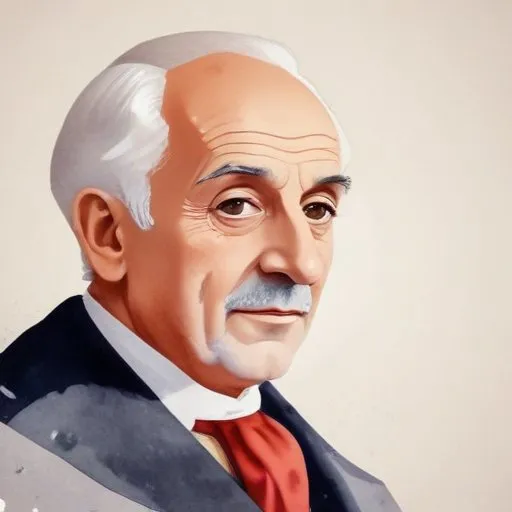
Renzo De Felice: The Pioneering Historian of Fascist Italy
A Biographer of Mussolini and Chronicler of Fascism
Renzo De Felice is renowned for his monumental, 4-volume biography of
Benito Mussolini, a work that spans over 6,000 pages and took nearly three decades to complete. This magnum opus, published between 1965 and 1997, cemented De Felice's reputation as a leading historian of Fascist Italy, offering a nuanced and controversial reassessment of Mussolini's regime.
Early Life and Education
Born on April 8, 1929, in Rieti, Italy, De Felice pursued his academic interests at the Sapienza University of Rome, where he studied under the tutelage of esteemed historians Federico Chabod and Delio Cantimori. During his student years, De Felice was an active member of the Italian Communist Party, but he severed ties with the party following the Soviet repression of the Hungarian Revolution in 1956.
Academic Career and Controversies
De Felice went on to teach history at the University of Rome, where he founded and edited the influential journal
Storia Contemporanea. His research focused primarily on Fascism, and his work was not without controversy. De Felice's biography of Mussolini has been both praised and criticized for its attempt to humanize the dictator and present a more balanced view of his regime. Some historians, like Philip Morgan, have argued that De Felice's work is problematic and lacks scientific objectivity.
Interpretations of Fascism
De Felice's most significant contribution to the field of historical scholarship lies in his conceptualization of Fascism as a dual phenomenon: Fascism as a movement and Fascism as a regime. He saw Fascism as a revolutionary middle-class ideology with roots in the Enlightenment, rather than simply a response to the fear of proletarian revolution. This interpretation has been widely debated and contested by other historians.
Other Notable Works and Contributions
In addition to his Mussolini biography, De Felice wrote a well-regarded history of Jewish life under the Fascist government and penned articles on Italian Jacobinism. His work has shed new light on the complex and multifaceted nature of Fascism, encouraging a more nuanced understanding of this pivotal period in Italian history.
Personal Life and Legacy
De Felice married Livia De Ruggiero and passed away on May 25, 1996, in Rome. His legacy continues to shape the field of historical studies, inspiring new generations of scholars to engage with the complexities of Fascism and its ongoing relevance to modern society.
Trivia and Fun Facts
- De Felice was a self-proclaimed liberal Jew, which influenced his perspective on Fascism and its treatment of Jewish communities.
- He was one of the 101 Italian intellectuals who condemned the Soviet Union's actions during the Hungarian Revolution of 1956.
- De Felice's biography of Mussolini was incomplete at the time of his death, with the final volume published posthumously.
Influence on Modern Society
De Felice's work has had a profound impact on our understanding of Fascism and its ongoing relevance to contemporary politics. His research has encouraged historians and scholars to reexamine the complexities of Fascist ideology and its legacy in modern society. As a result, De Felice's contributions continue to shape our understanding of the past and its ongoing influence on the present.
FAQ
What is Renzo De Felices contribution to Italian historiography?
Renzo De Felice, an Italian historian and author, made significant contributions to the field of Italian historiography, particularly in the areas of fascism and Italian history during World War II.
What was Renzo De Felices stance on fascism?
Renzo De Felice was known for his revisionist approach to the study of fascism, arguing that it was a more complex and nuanced phenomenon than previously understood.
What was Renzo De Felices methodology as a historian?
Renzo De Felice was known for his rigorous and meticulous approach to historical research, and his work was characterized by a deep understanding of the social and political contexts of the periods he studied.
What were Renzo De Felices most important works?
Renzo De Felices most important works include his multi-volume history of Italian fascism, Storia degli ebrei italiani sotto il fascismo, and his biography of Benito Mussolini.
What is Renzo De Felices legacy in Italian academia?
Renzo De Felices legacy in Italian academia is one of excellence and innovation, and his work continues to influence and inform new generations of historians and scholars.