


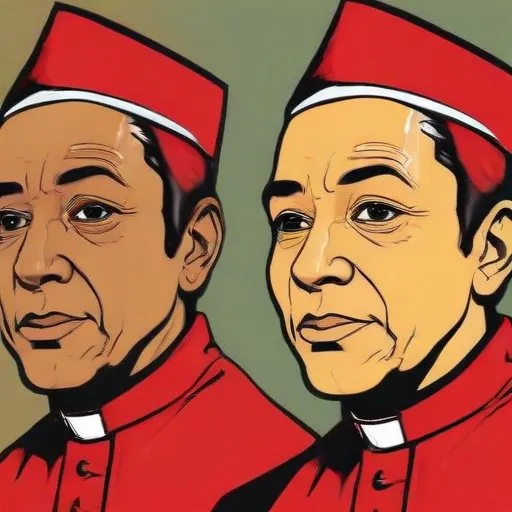
A prominent Catholic Church leader, known for his advocacy of social justice and human rights, particularly in the Philippines during a tumultuous period of martial law.
Ricardo Vidal is synonymous with Catholic leadership in the Philippines, having served as the Archbishop of Cebu from 1982 to 2010 and becoming a cardinal in 1985. Throughout his illustrious career, he has been an influential figure in the Catholic Church, shaping the country's religious landscape and leaving an indelible mark on millions of Filipinos.
Vidal was born on February 6, 1931, in Mogpog, Marinduque, to Faustino S. Vidal and Natividad Jamin. He received his primary education at Mogpog Elementary School and went on to study at the Minor Seminary of the Most Holy Rosary, now known as Our Lady of Mount Carmel Seminary, in Sariaya, Quezon. Later, he pursued his studies in philosophy at the Saint Francis de Sales Seminary in Lipa, Batangas, and theology at the San Carlos Seminary in Makati, Metro Manila.
Vidal's ministerial journey began when he was ordained as a deacon on September 24, 1955, and subsequently as a priest on March 17, 1956. He served as the spiritual director of the Our Lady of Mount Carmel Seminary in Sariaya, Quezon, before being appointed Coadjutor Bishop of Malolos in 1971. Two years later, he became the Bishop of Lipa, and in 1981, Pope John Paul II appointed him Coadjutor Archbishop of Cebu, where he succeeded Cardinal Julio Rosales in 1982.
Throughout his tenure as Archbishop of Cebu, Vidal worked closely with Bishop Teofilo Camomot, bearing witness to the latter's alleged miraculous deeds. He also played a significant role in the establishment of the Catechist Missionaries of St. Theresa, a Catholic religious congregation.
Vidal's leadership extended beyond his diocese. He served as the President of the Catholic Bishops' Conference of the Philippines (CBCP) from 1986 to 1987 and later became the Chairman of the CBCP's Episcopal Commission on the Clergy in 1989. His influence also reached international circles, as he collaborated with the Federation of Asian Bishops' Conferences.
His commitment to the clergy and the faithful earned him a reputation as a compassionate and dedicated leader. Vidal's contributions to the Catholic Church in the Philippines are a testament to his unwavering dedication to his faith and his people.
Ricardo Vidal's life and ministry have left an indelible mark on the Catholic Church in the Philippines. As a cardinal, archbishop, and leader, he has inspired countless individuals and shaped the country's religious landscape. His legacy continues to inspire generations of Filipinos, serving as a beacon of hope and faith in a rapidly changing world.
Through his tireless efforts, Vidal has demonstrated that true leadership is not about personal gain, but about serving others. His life is a testament to the power of faith, compassion, and dedication, leaving behind a lasting legacy that will continue to inspire and guide the faithful for generations to come.
94 Years Old
A Filipino cardinal who served as the Archbishop of Manila and was a key figure in the country's Catholic Church, known for his advocacy on social justice and human rights issues.
Born in 1906
A Filipino cardinal who served as the Archbishop of Cebu and was a key figure in the country's Catholic Church, known for his advocacy on social justice and human rights issues.
