


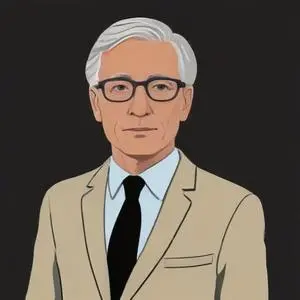
Pioneering researcher who linked smoking to lung cancer, revolutionizing our understanding of the risks associated with tobacco use.
Sir Richard Doll, a British physician and epidemiologist, is renowned for being one of the first scientists to conclusively link smoking to an increased risk of lung cancer and heart disease. His groundbreaking research in the mid-20th century revolutionized our understanding of the devastating health effects of tobacco consumption.
Born on October 28, 1912, in Hampton, Middlesex, Doll came from an affluent family. His father, a doctor, was cut short by multiple sclerosis, which had a profound impact on Doll's life. Despite his parents' wishes, Doll initially wanted to pursue mathematics at Trinity College, Cambridge. However, after failing to secure a mathematics scholarship, allegedly due to the effects of drinking three pints of the College's own-brewed beer the night before, he opted to study medicine at St. Thomas's Hospital Medical School (now part of King's College London).
Doll's research focused on the relationship between environmental factors and disease. He worked closely with other prominent epidemiologists, including Ernst Wynder, Bradford Hill, and Evarts Graham, to demonstrate the causal link between smoking and lung cancer, as well as heart disease. German studies had hinted at this connection as early as the 1920s, but Doll's work provided conclusive evidence that was impossible to ignore.
In addition to his work on smoking, Doll made significant contributions to our understanding of the health risks associated with radiation, asbestos, and alcohol consumption. He was a pioneer in researching the link between radiation and leukemia, as well as the connection between asbestos and lung cancer. His work also explored the relationship between alcohol consumption and breast cancer.
Doll's groundbreaking research earned him numerous awards and honors. He was knighted in 1967 for his services to medicine. He also received the Royal Medal in 1986, the Copley Medal in 1992, and the United Nations Environment Programme's Global 500 Roll of Honour in 1990.
Sir Richard Doll's work has had a profound impact on modern society. His research has saved countless lives by raising awareness about the dangers of smoking and environmental pollutants. His legacy extends beyond the scientific community, influencing public health policy and inspiring future generations of epidemiologists.
In 2012, Doll was featured in an episode of the BBC Radio Four series "The New Elizabethans," which celebrated 60 public figures who made significant contributions to society during Queen Elizabeth II's reign.
Doll was a self-proclaimed socialist and an active member of the Socialist Medical Association. His commitment to social justice and equality guided his work, and he played a key role in the campaign that led to the creation of Britain's post-war National Health Service.
Despite his many achievements, Doll was not without controversy. He initially opposed research done by Alice Stewart, which linked radiation exposure of pregnant mothers to the development of leukemia in their children, due to concerns about her analytical methods.
Sir Richard Doll passed away on July 24, 2005, leaving behind a legacy that continues to shape our understanding of the intricate relationships between environment, lifestyle, and disease. His pioneering work serves as a testament to the power of dedicated research and its potential to transform public health policy and improve human lives.
Born in 1886
A pioneering physiologist who discovered the production of heat in muscles, leading to a deeper understanding of muscle physiology, and was a prominent advocate for women's rights and education.
Born in 1783
A Romantic-era artist capturing the beauty of the English countryside through serene and detailed landscapes, often featuring tranquil skies and rustic scenery.
54 Years Old
A renowned fashion photographer and author, known for his work on America's Next Top Model and capturing stunning images for top fashion brands.
Born in 1813
Pioneering doctor who tracked down the source of a cholera outbreak in London, leading to significant advances in public health and epidemiology. Known for his groundbreaking work in tracing the disease to a contaminated water pump.
