


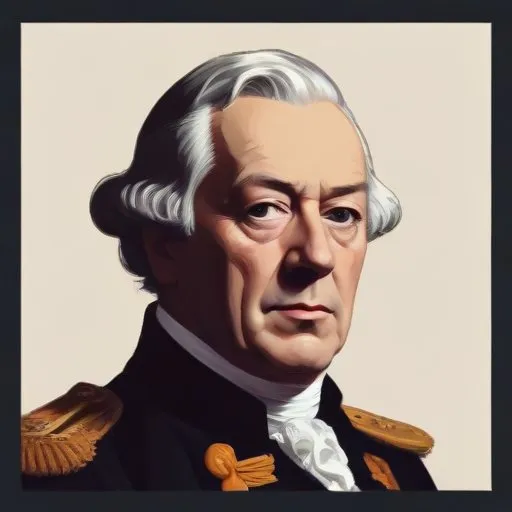
A renowned British naval officer and politician who played a key role in the American Revolutionary War and later became Treasurer of the Navy, known for his tactical genius and bravery at sea.
Renowned for his unwavering bravery and exceptional naval prowess, Richard Howe, 1st Earl Howe, left an indelible mark on British naval history. His illustrious career spanned multiple conflicts, including the War of the Austrian Succession, the Seven Years War, the American Revolutionary War, and the French Revolutionary Wars, earning him a reputation as one of the most accomplished admirals of his time.
Born on March 8, 1726, in Albemarle Street, London, Howe was the second son of Emanuel Howe, 2nd Viscount Howe, and Charlotte, a daughter of Baroness von Kielmansegg. After completing his education at Eton College, Howe entered the navy in 1739, serving on various ships, including the HMS Pearl, HMS Severn, and HMS Burford.
During the American Revolutionary War, Howe acted as a naval commander and peace commissioner, engaging with American rebels in an effort to negotiate a peaceful resolution. His relief of the Great Siege of Gibraltar in 1782 was a notable achievement, cementing his reputation as a master of naval strategy.
In 1794, Howe commanded the victorious British fleet during the Glorious First of June, a decisive battle that showcased his tactical genius and earned him widespread acclaim.
Howe's exceptional service was recognized with numerous honors, including his appointment as Admiral of the Fleet in 1796. He was also created 1st Earl Howe in 1788, a testament to his unwavering dedication to the British Navy.
Richard Howe, 1st Earl Howe, remains an iconic figure in British naval history, his name synonymous with courage, strategic brilliance, and unwavering dedication to duty. His remarkable career continues to inspire generations, serving as a testament to the power of excellence and determination.
66 Years Old
A renowned jockey and trainer, he won numerous prestigious races, including the Epsom Derby and St. Leger Stakes, and was known for his exceptional riding skills and innovative training methods.
Born in 1704
An 18th-century naval officer who governed Newfoundland and was court-martialed for failing to engage the enemy, leading to reforms in the British Navy's rules of engagement. He's infamous for being the first British admiral executed for cowardice.
