


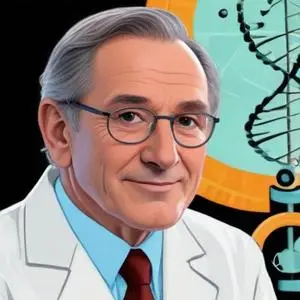
Discovered and characterized split genes, and developed methods for identifying and isolating genes, leading to major advances in genetic engineering and biotechnology.
Sir Richard J. Roberts is a British biochemist and molecular biologist who was awarded the 1993 Nobel Prize in Physiology or Medicine for his groundbreaking discovery of introns in eukaryotic DNA and the mechanism of genesplicing. This pioneering work, done in collaboration with Phillip Allen Sharp, has had a profound impact on the field of molecular biology and its applications.
Sir Richard John Roberts was born on September 6, 1943, in Derby, England, to Edna Allsop and John Roberts, an auto mechanic. When he was just four years old, his family moved to Bath, where he attended the City of Bath Boys School. As a young boy, Roberts was fascinated by chemistry and subsequently pursued a degree in the subject.
In 1965, Roberts graduated from the University of Sheffield with a Bachelor of Science degree in chemistry. He then went on to earn his PhD in 1969, with a thesis that involved phytochemical studies of neoflavonoids and isoflavonoids.
Following his PhD, Roberts conducted postdoctoral research at Harvard University from 1969 to 1972. This was followed by a stint at Cold Spring Harbor Laboratory, where he was hired by the renowned James Dewey Watson, a codiscoverer of the structure of DNA and a fellow Nobel laureate. During this period, Roberts also spent time at the MRC Laboratory of Molecular Biology, working alongside Fred Sanger.
In 1977, Roberts published his landmark paper on RNA splicing, a discovery that would change the face of molecular biology. This work led to a fundamental shift in our understanding of genetics and paved the way for the discovery of split genes in higher organisms, including human beings.
In recognition of his outstanding contributions to the field of molecular biology, Sir Richard J. Roberts was awarded the Nobel Prize in Physiology or Medicine in 1993, along with Phillip Allen Sharp. This prestigious honor is a testament to his pioneering work and its impact on our understanding of genetics.
Sir Richard J. Roberts' discovery of alternative splicing of genes has had far-reaching implications for the study and applications of molecular biology. His work has opened up new avenues for research into the complex mechanisms of gene expression and has paved the way for the development of innovative treatments for a range of diseases.
Today, Sir Richard J. Roberts continues to work at New England Biolabs, where he remains an active and influential voice in the scientific community. His groundbreaking work has left an indelible mark on the field of molecular biology, and his legacy will continue to inspire future generations of scientists and researchers.
Born in 1916
Pioneering scientist who discovered the structure of DNA, revolutionizing our understanding of genetics and life itself.
98 Years Old
Discovered the structure of DNA, revolutionizing our understanding of genetics and earning a Nobel Prize. Pioneering work in molecular biology has far-reaching implications for medicine and beyond.
Born in 1920
A British scientist who contributed significantly to the discovery of the structure of DNA, providing high-quality X-ray crystallography images that helped James Watson and Francis Crick develop their famous model.
Born in 1916
A Nobel Prize-winning physicist and biologist who contributed significantly to the discovery of the structure of DNA, using X-ray crystallography to produce the first clear images of the molecule.
Born in 1924
A pioneer in the field of atmospheric physics, known for his groundbreaking research on the ozone layer and climate change, and a vocal skeptic of global warming theories.
Born in 1914
Pioneering crystallographer who unraveled the structure of hemoglobin, revolutionizing our understanding of biological molecules. His work paved the way for major advances in medicine and biochemistry.
Born in 1917
Pioneering biochemist and crystallographer who determined the structure of myoglobin, a protein in muscle cells, and was awarded the Nobel Prize in Chemistry in 1962.
Born in 1910
A pioneering scientist who deciphered the structures of biomolecules like insulin and vitamin B12, revolutionizing our understanding of biology and medicine.
