


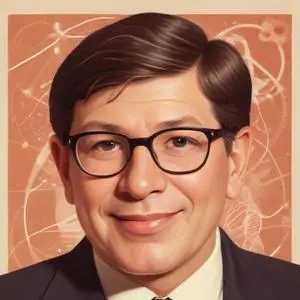
A prominent biologist and geneticist who challenged traditional views on evolution and race, and is known for his critiques of biological determinism and sociobiology.
Richard Lewontin, a renowned American evolutionary biologist, mathematician, and geneticist, is best known for developing the mathematical basis of population genetics and evolutionary theory. Through his groundbreaking work, he applied techniques from molecular biology to questions of genetic variation and evolution, revolutionizing the field of molecular evolution.
Lewontin was born on March 29, 1929, in New York City to parents of Ashkenazi Jewish descent. He attended Forest Hills High School and later graduated from Harvard College with a BS degree in biology in 1951. He then went on to earn his MS degree in mathematical statistics in 1952 and a PhD degree in zoology in 1954 from Columbia University, where he was a student of Theodosius Dobzhansky.
Lewontin's career was marked by several notable achievements. In 1966, he co-authored two seminal papers with J. L. Hubby in the journal Genetics, which laid the foundation for the modern field of molecular evolution. In 1979, he and Stephen Jay Gould introduced the term "spandrel" into evolutionary theory. Throughout his career, he held faculty positions at North Carolina State University, the University of Rochester, and the University of Chicago, before becoming the Alexander Agassiz Professor of Zoology and Professor of Biology at Harvard University in 1973.
Lewontin was a vocal critic of genetic determinism and neodarwinism, particularly in the fields of sociobiology and evolutionary psychology. He believed that genetics played a limited role in shaping human behavior and that social and environmental factors were more significant. He was also an outspoken advocate for social justice and condemned the involvement of prominent scientists in Pentagon programs aimed at developing weapons for the Vietnam War.
Lewontin's work has had a profound impact on modern society. His research on genetic variation and evolution has contributed significantly to our understanding of the natural world. Additionally, his critique of genetic determinism has influenced the way we think about the relationship between genetics and human behavior. His advocacy for social justice and environmental sustainability has inspired a new generation of scientists and activists.
Lewontin received numerous awards and honors for his contributions to science, including the National Medal of Science in 1994 and the Crafoord Prize in 2008. He was also elected as a member of the National Academy of Sciences and the American Academy of Arts and Sciences.
Lewontin's critiques of genetic determinism and neodarwinism have been met with controversy and criticism from some quarters. However, his work has also been widely praised for its intellectual rigor and its challenge to prevailing orthodoxies.
Lewontin's personal life was marked by significant milestones, including his marriage to actress and writer, Mary Jane Simpson, and the birth of their two children. He passed away on July 4, 2021, at the age of 92, leaving behind a legacy of groundbreaking research and a commitment to social justice.
Richard Lewontin's contributions to science and society have left a lasting impact on our understanding of genetics, evolution, and the natural world. His commitment to social justice and environmental sustainability has inspired a new generation of scientists and activists. As we look to the future, his work serves as a reminder of the importance of critically evaluating the role of science in shaping our world.
84 Years Old
A renowned paleontologist, biologist, and author who challenged traditional views on evolution and natural history through engaging writings and groundbreaking research.
97 Years Old
A renowned biologist and author who has made groundbreaking contributions to our understanding of ecology, evolution, and conservation, and is known for his advocacy for biodiversity and the preservation of natural habitats.
98 Years Old
Discovered the structure of DNA, revolutionizing our understanding of genetics and earning a Nobel Prize. Pioneering work in molecular biology has far-reaching implications for medicine and beyond.
Born in 1916
Pioneering scientist who discovered the structure of DNA, revolutionizing our understanding of genetics and life itself.
Born in 1920
A British scientist who contributed significantly to the discovery of the structure of DNA, providing high-quality X-ray crystallography images that helped James Watson and Francis Crick develop their famous model.
Born in 1900
A pioneer in evolutionary biology, he integrated genetics and evolution, revolutionizing our understanding of species adaptation and diversity. His work laid the foundation for modern evolutionary theory.
Born in 1904
A renowned biologist and ornithologist who pioneered the modern synthesis of evolutionary biology, shaping our understanding of species and their diversity.
