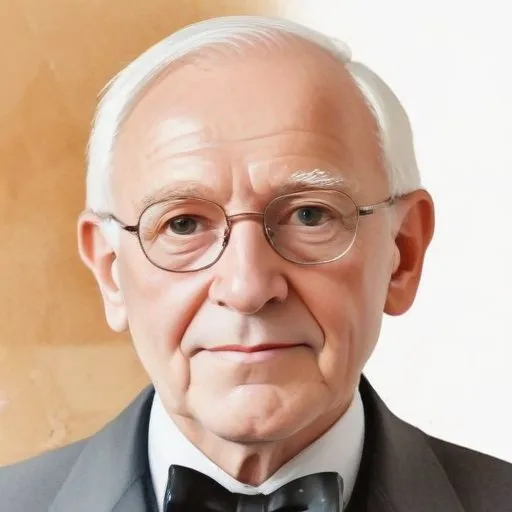
Richard Smalley: The Nobel Laureate Who Unlocked the Secrets of Carbon
A Pioneer in Nanotechnology and Chemistry
Richard Errett Smalley is renowned for his groundbreaking discovery of buckminsterfullerene, a new form of carbon, also known as buckyballs. This pioneering work, accomplished in collaboration with
Robert Curl and Harold Kroto, earned him the Nobel Prize in Chemistry in 1996.
Early Life and Education
Born on June 6, 1943, in Akron, Ohio, Smalley was the youngest of four siblings. He grew up in Kansas City, Missouri, surrounded by a family that instilled in him a love for science and chemistry. His father, Frank Dudley Smalley, Jr., worked with mechanical and electrical equipment, while his mother, Esther Virginia Rhoads, completed her B.A. degree during Richard's teenage years. His maternal aunt, Sara Jane Rhoads, a pioneering female chemist, played a significant role in nurturing his interest in chemistry.
Academic Pursuits and Research
Smalley attended Hope College for two years before transferring to the University of Michigan, where he earned his Bachelor of Science in 1965. He then worked in industry, developing his unique managerial style, before pursuing his Ph.D. from Princeton University in 1973. His doctoral dissertation, titled "The lower electronic states of the Group IVB diatomic molecules," laid the foundation for his future research.
Discovery of Buckminsterfullerene
In 1985, Smalley, along with Curl and Kroto, discovered buckminsterfullerene, a molecule consisting of 60 carbon atoms arranged in a spherical shape. This breakthrough led to a deeper understanding of carbon's properties and paved the way for significant advances in nanotechnology.
Career Highlights and Advocacy
Smalley's work earned him numerous accolades, including the Nobel Prize, the APS Oliver E. Buckley Condensed Matter Prize, and the Feynman Prize in Nanotechnology. As the Gene and Norman Hackerman Professor of Chemistry, Physics, and Astronomy at Rice University, he advocated for the development and application of nanotechnology, inspiring a new generation of scientists.
Philosophical Contributions and Beliefs
Smalley believed in the immense potential of nanotechnology to address global challenges, such as energy production, environmental sustainability, and healthcare. He envisioned a future where scientists and engineers worked together to create innovative solutions that benefited humanity.
Personal Milestones and Legacy
Smalley's legacy extends beyond his scientific contributions. He was a devoted husband and father, and his love for science wasrivaled only by his love for his family. He passed away on October 28, 2005, leaving behind a rich legacy that continues to inspire scientists, engineers, and environmentally conscious individuals worldwide.
Quotes and Memorable Sayings
- "The most important thing in science is not so much to obtain new facts as to discover new ways of thinking about them."
- "Nanotechnology has the potential to revolutionize the way we live, work, and interact with the environment."
Charitable Work and Social Contributions
Throughout his career, Smalley was an ardent advocate for environmental sustainability and social responsibility. He worked tirelessly to promote the responsible development and application of nanotechnology, ensuring its benefits were accessible to all.
Inspirational Stories and Motivations
Smalley's journey serves as a testament to the power of curiosity, hard work, and perseverance. His groundbreaking discoveries and advocacy for responsible science continue to inspire generations of scientists, engineers, and environmentalists, leaving a lasting impact on the world.