


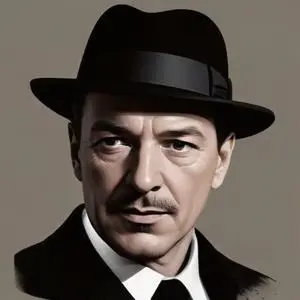
A German journalist and spy who infiltrated the highest levels of the Nazi government, providing crucial intel to the Soviet Union during World War II.
Richard Sorge, codename Ramsay, was a German journalist and Soviet military intelligence officer who pulled off one of the most daring feats of espionage in history. His bravery and cunning provided crucial information about Adolf Hitler's plan to attack the Soviet Union, saving countless lives and altering the course of World War II.
Born on October 4, 1895, in Sabunchi, a suburb of Baku, Azerbaijan, Sorge was the youngest of nine children to Gustav Wilhelm Richard Sorge, a German mining engineer, and his Russian wife, Nina Semionovna Kobieleva. The Sorge family moved back to Germany in 1898, where Richard attended Oberrealschule Lichterfelde. His father's nationalist and imperialist views had a significant impact on his early life, but the cosmopolitan atmosphere of his household, influenced by his mother's Russian heritage, instilled in him a unique worldview.
Sorge's journalism career took him to Germany, where he became a member of the Communist Party of Germany and began working undercover for the Soviet Union. In 1940, he was stationed in Japan, where he gathered intelligence on the Japanese government's military plans. Under the guise of a German journalist, Sorge befriended high-ranking Japanese officials, including the German ambassador to Japan, Eugen Ott.
In 1941, Sorge provided the Soviet Union with crucial information about Hitler's plan to attack the Soviet Union, known as Operation Barbarossa. This intelligence allowed the Soviet military to prepare for the invasion, ultimately saving thousands of lives. Later that year, Sorge informed the Soviets that Japan would not attack the Soviet Union in the near future, allowing the Red Army to redirect troops to the Eastern Front.
In mid-September 1941, Sorge's luck ran out. He was arrested by Japanese authorities on suspicion of espionage. Despite being brutally tortured, Sorge refused to reveal his true identity or the extent of his espionage activities. In a cruel twist of fate, Sorge was forced to confess, and in November 1944, he was hanged in Sugamo Prison, Tokyo.
In a shocking betrayal, Stalin declined to intervene on Sorge's behalf, unwilling to risk damaging relations with Japan. Sorge's bravery and sacrifice would not be recognized until 1964, when he was posthumously awarded the title of Hero of the Soviet Union.
Richard Sorge's remarkable story serves as a testament to the power of courage and conviction. His bravery salvaged countless lives and altered the course of World War II. His legacy extends beyond the realm of espionage, inspiring generations to come.
In a world where loyalty and betrayal walk a thin line, Richard Sorge's unwavering commitment to his ideals has cemented his place in history as one of the greatest spies of all time.
Born in 1878
The Soviet Union's ruthless leader who ruled with an iron fist, implementing policies that led to widespread famine and purges, while also playing a crucial role in defeating Nazi Germany in World War II.
Born in 1896
A Soviet military leader who played a crucial role in defeating Nazi Germany in World War II, and later became a key figure in Soviet politics.
Born in 1870
Founder of the world's first socialist state, leading the Bolshevik Revolution and establishing the Soviet Union, known for his radical Marxist ideology and authoritarian rule.
Born in 1911
A German-born physicist who contributed significantly to the development of the atomic bomb, while secretly passing nuclear secrets to the Soviet Union during the Cold War.
Born in 1894
A high-ranking Nazi official who flew to Scotland on a solo mission to negotiate peace with the UK, but was instead arrested and imprisoned.
Born in 1893
A German diplomat who served as the Nazi regime's Foreign Minister, orchestrating key alliances and treaties that led to World War II. He was a close associate of Adolf Hitler and played a crucial role in shaping Nazi foreign policy.
Born in 1890
A Soviet Minister of Foreign Affairs who played a crucial role in shaping the country's foreign policy during World War II and the early Cold War era, known for his diplomatic skills and signature cocktails.
Born in 1899
Soviet Union's ruthless secret police chief, responsible for millions of deaths and brutal suppressions during Stalin's regime, known for his cunning and feared reputation.
