


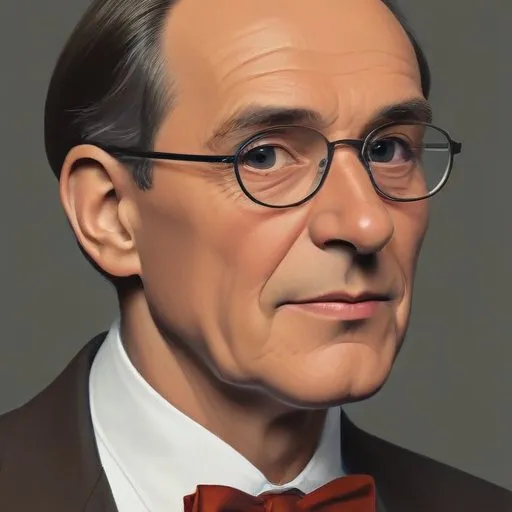
A German-Swiss chemist and academic who discovered the structure of chlorophyll, the green pigment in plants, and was awarded the Nobel Prize in Chemistry in 1915. His work laid the foundation for modern plant biochemistry.
Richard Willsttter, a German organic chemist, is renowned for his groundbreaking research on the structure of plant pigments, including the coveted chlorophyll, which earned him the 1915 Nobel Prize for Chemistry. His work revolutionized the understanding of plant biology, shedding light on the intricate chemistry behind nature's palette.
Born on August 13, 1872, in Karlsruhe, Germany, Willsttter was the son of Maxwell Max Willsttter, a textile merchant, and Sophie Ulmann. He attended the Karlsruhe Gymnasium and later the Technical School in Nuremberg, before pursuing his passion for science at the University of Munich. There, he spent 15 years studying and working under the guidance of Alfred Einhorn, earning his doctorate in 1894 with a thesis on the structure of cocaine.
Willsttter's fascination with alkaloids led him to synthesize several compounds, which earned him recognition in the scientific community. In 1896, he became a lecturer, and in 1902, a professor extraordinarius at the University of Munich. His work on chlorophyll began to take shape during his tenure at the ETH Zürich, where he became a professor in 1905. He successfully determined the empirical formula of chlorophyll, paving the way for future research.
Willsttter's most significant contributions came during his time at the University of Berlin, where he became a professor of chemistry in 1912 and director of the Kaiser Wilhelm Institute for Chemistry. He dedicated himself to the study of flower and fruit pigments, leading to the discovery that chlorophyll was a mixture of two compounds: chlorophyll a and chlorophyll b. This breakthrough had far-reaching implications for our understanding of plant biology and photosynthesis.
In 1915, Willsttter was approached by his friend Fritz Haber to participate in the development of poison gases during World War I. While he refused to contribute to the war effort in this way, he did work on developing a three-layer filter to protect against gas attacks. This invention earned him the Iron Cross Second Class, and by 1917, 30 million of these filters had been manufactured.
After the war, Willsttter returned to Munich, succeeding his mentor, Adolf von Baeyer, as a professor of chemistry. His dedication to his craft and his contributions to the field of chemistry solidified his position as a pioneer in the scientific community.
Richard Willsttter's groundbreaking research and contributions to the field of chemistry continue to inspire and influence scientists to this day. His legacy serves as a testament to the power of human curiosity and the importance of fundamental scientific research.
Born in 1835
German chemist and Nobel laureate who synthesized barbituric acid and developed the theory of organic dyes, revolutionizing the textile industry. His work laid the foundation for modern dye chemistry.
Born in 1868
Developed a process to synthesize ammonia, revolutionizing agriculture and warfare, and was awarded the Nobel Prize in Chemistry in 1918.
Born in 1847
A German chemist and academic who pioneered the field of alicyclic compounds and was awarded the Nobel Prize in Chemistry in 1910 for his work on alkaloids. He discovered and characterized many new compounds, significantly advancing the field of organic chemistry.
Born in 1852
Pioneering chemist who discovered the laws of chemical equilibrium and osmotic pressure, revolutionizing our understanding of chemical reactions.
Born in 1853
A Latvian-German chemist and academic who pioneered work on catalysis, chemical equilibria, and reaction rates, earning a Nobel Prize in Chemistry in 1909. He's also credited with developing the Ostwald process for producing nitric acid.
Born in 1852
A German chemist and academic who won the Nobel Prize for synthesizing amino acids and sugars, and establishing the structure of purines, revolutionizing the field of organic chemistry.
Born in 1871
A French chemist and academic who developed the Grignard reaction, a crucial process in organic chemistry that enables the formation of carbon-carbon bonds, revolutionizing the field.
