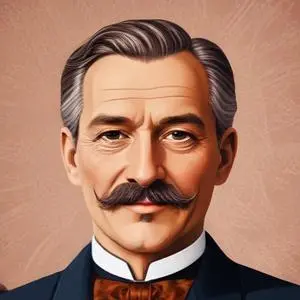
Wilhelm Ostwald

Wilhelm Ostwald

Wilhelm Ostwald was born on September 2nd, 1853

Full Name: Wilhelm Ostwald
Birth Date: September 2, 1853
Birth Place: Riga, Latvia
Occupation: Chemist and Academic
Notable Work: Catalysis
Awards: Nobel Prize in Chemistry
Influence: Physical Chemistry
Death Date: April 4, 1932

A Latvian-German chemist and academic who pioneered work on catalysis, chemical equilibria, and reaction rates, earning a Nobel Prize in Chemistry in 1909. He's also credited with developing the Ostwald process for producing nitric acid.

Timeline
1853
Born in Riga
Wilhelm Ostwald was born in Riga, Latvia. He would go on to become a prominent chemist and academic.
1872
Earns PhD from University of Dorpat
Ostwald earns his PhD from the University of Dorpat, where he would later become a professor.
1881
Discovers Catalysis
Ostwald discovers the concept of catalysis, a fundamental principle in chemistry.
1894
Becomes Professor at University of Leipzig
Ostwald becomes a professor at the University of Leipzig, where he would teach for over 20 years.
1932
Passes Away
Wilhelm Ostwald passes away at the age of 79, leaving behind a legacy as a Nobel Prize-winning chemist.
Wilhelm Ostwald

Wilhelm Ostwald Quiz

What field of science did Wilhelm Ostwald make significant contributions to?

Score: 0/5
FAQ
What was Wilhelm Ostwalds most significant scientific contribution?
Wilhelm Ostwald was a Nobel Prize-winning chemist, best known for his work on catalysis and his development of the Ostwald process for the production of nitric acid.
What was Wilhelm Ostwalds role in the development of modern chemistry?
Wilhelm Ostwald played a key role in the development of modern chemistry, helping to establish the foundation of modern physical chemistry. His work on catalysis and chemical kinetics helped shape our understanding of chemical reactions.
What were Wilhelm Ostwalds areas of research focus?
Wilhelm Ostwalds research focused on physical chemistry, electrochemistry, and chemical kinetics. He made significant contributions to our understanding of chemical reactions, catalysis, and the behavior of electrolytes.
What was Wilhelm Ostwalds role in the Nobel Prize committee?
Wilhelm Ostwald was a member of the Nobel Prize committee, helping to select winners in the field of chemistry. He was awarded the Nobel Prize in Chemistry in 1909 for his work on catalysis.
What was Wilhelm Ostwalds legacy in the scientific community?
Wilhelm Ostwalds legacy in the scientific community is significant, with many chemists and scientists drawing on his work and ideas. He helped establish the importance of physical chemistry and catalysis in modern chemistry.

Related People:

Svante Arrhenius

Born in 1859

A Nobel Prize-winning physicist and chemist who pioneered the understanding of acid-base chemistry and greenhouse gases, laying the foundation for modern climate science.

Jacobus Henricus van 't Hoff

Born in 1852

Pioneering chemist who discovered the laws of chemical equilibrium and osmotic pressure, revolutionizing our understanding of chemical reactions.

Hermann Emil Fischer

Born in 1852

A German chemist and academic who won the Nobel Prize for synthesizing amino acids and sugars, and establishing the structure of purines, revolutionizing the field of organic chemistry.

Fritz Haber

Born in 1868

Developed a process to synthesize ammonia, revolutionizing agriculture and warfare, and was awarded the Nobel Prize in Chemistry in 1918.

Erwin Bauer

Born in 1912

German racing driver who won the 1927 German Grand Prix and was one of the first drivers to compete in the European Championship.

Theodor Svedberg

Born in 1884

Developer of the ultracentrifuge, a device that separates particles based on size and density, revolutionizing biochemistry and molecular biology research.

Victor Grignard

Born in 1871

A French chemist and academic who developed the Grignard reaction, a crucial process in organic chemistry that enables the formation of carbon-carbon bonds, revolutionizing the field.