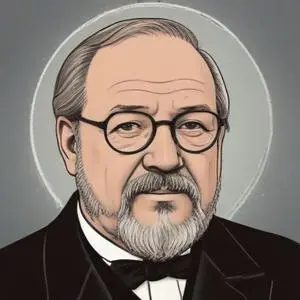
Svante Arrhenius: The Father of Physical Chemistry and Climate Science Pioneer
The Nobel Laureate Who Predicted Global Warming
Svante Arrhenius is renowned for being the first scientist to estimate the extent to which increases in atmospheric carbon dioxide are responsible for the Earth's increasing surface temperature. This groundbreaking work in the late 19th century laid the foundation for modern climate science, earning him the Nobel Prize in Chemistry in 1903.
Early Life and Education
Born on February 19, 1859, in Vik, Sweden, Arrhenius was a child prodigy who taught himself to read at the age of three and demonstrated exceptional mathematical abilities. He entered the local cathedral school at eight and went on to study at the University of Uppsala, where he earned his Ph.D. in 1884.
Contributions to Physical Chemistry
Arrhenius is considered one of the founders of physical chemistry, a field that combines physics and chemistry to study the physical properties and behavior of matter. His work on electrolytic dissociation, which posits that substances dissociate into ions when dissolved in water, revolutionized the field and led to the development of modern electrochemistry.
The Arrhenius Equation
One of Arrhenius' most significant contributions is the Arrhenius equation, which describes the temperature dependence of the rate constant in chemical reactions. This equation, still widely used today, has had a profound impact on our understanding of chemical kinetics and reaction mechanisms.
Climate Science and the Greenhouse Effect
Arrhenius' work on the carbon dioxide-greenhouse effect was well ahead of its time. In 1896, he published a paper estimating the extent to which increases in atmospheric CO2 would lead to global warming. His calculations, although simplified by modern standards, demonstrated a remarkable understanding of the underlying principles.
Influence on Modern Climate Science
Arrhenius' pioneering work on climate science paved the way for subsequent researchers, including Charles David Keeling, who in the 1960s reliably measured the increasing levels of CO2 in the atmosphere. Today, Arrhenius is recognized as a visionary who played a crucial role in shaping our understanding of the Earth's climate system.
Awards and Honors
- Nobel Prize in Chemistry (1903)
- Director of the Nobel Institute (1905-1927)
- Member of the Royal Swedish Academy of Sciences
- Member of the Royal Swedish Academy of Engineering Sciences
Legacy and Commemoration
Arrhenius' contributions to science are commemorated through various namesakes, including:
- Arrhenius equation
- Arrhenius acid and base
- Lunar crater Arrhenius
- Martian crater Arrhenius
- Mountain of Arrheniusfjellet
- Arrhenius Labs at Stockholm University
Personal Life and Milestones
Arrhenius was a passionate advocate for scientific education and was known for his exceptional teaching skills. He married twice and had two sons, one of whom, Olof Arrhenius, became a prominent Swedish engineer.
Quotes and Memorable Sayings
"Science is not everything, but science is very close to everything." - Svante Arrhenius
Historical Context and Legacy
Arrhenius' work in the late 19th and early 20th centuries laid the foundation for many subsequent scientific discoveries. His legacy continues to inspire researchers and scientists today, serving as a testament to the power of human curiosity and innovation.
Predictions and Speculations
As we look to the future, Arrhenius' work serves as a reminder of the importance of addressing climate change and its far-reaching consequences. His pioneering spirit and dedication to scientific inquiry continue to inspire new generations of researchers, policymakers, and thinkers.
FAQ
What was Svante Arrheniuss contribution to the development of chemistry?
Svante Arrhenius was a pioneering chemist who made significant contributions to the development of chemistry. He was awarded the Nobel Prize in Chemistry in 1903 for his work on the dissociation of substances in water, and his theory of electrolytic dissociation is still widely used today.
What was Svante Arrheniuss approach to chemistry?
Svante Arrheniuss approach to chemistry was centered on the idea of understanding the behavior of substances at the molecular level. He was known for his innovative experiments and his development of new techniques, including the use of electrochemistry and spectroscopy.
What was Svante Arrheniuss significance in the development of physical chemistry?
Svante Arrhenius was a key figure in the development of physical chemistry, and his work helped to establish the field as a major area of research. His contributions to the development of thermodynamics, electrochemistry, and chemical kinetics continue to influence chemistry today.
What was Svante Arrheniuss relationship with other prominent chemists of his time?
Svante Arrhenius was a prominent figure in the chemical community of his time, and he had relationships with other prominent chemists, including Wilhelm Ostwald and Jacobus Henricus van t Hoff. He was also a member of several scientific societies and organizations, and he contributed to the development of chemistry research and education.
What is Svante Arrheniuss legacy in the field of chemistry?
Svante Arrheniuss legacy in the field of chemistry is significant, and he is still remembered as one of the most important chemists of the early 20th century. His contributions to the development of chemistry, physical chemistry, and chemical education continue to influence chemistry research and practice today.