


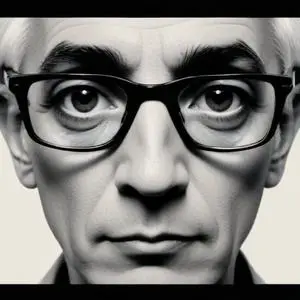
A pioneering filmmaker who stripped cinema to its essence, focusing on spiritual and emotional depth through minimalist storytelling. Known for his innovative, contemplative, and visually stunning films that explore the human condition.
French film director Robert Bresson is renowned for his distinct, minimalist approach to filmmaking, characterized by the use of non-professional actors, elliptical storytelling, and a sparse, contemplative score. His oeuvre has been hailed as a benchmark of cinematic artistry, earning him a reputation as one of the most highly regarded filmmakers of all time.
Born on September 25, 1901, in Bromont-Lamothe, Puy-de-Dôme, France, Bresson's early life remains somewhat of a mystery. However, it is known that he was educated at Lyce Lakanal in Sceaux, Hauts-de-Seine, and developed a passion for painting after graduating. Three formative influences had a profound impact on his films: Catholicism, art, and his experiences as a prisoner of war.
Bresson's cinematic journey began with short films, including Les affaires publiques (1934), before transitioning to feature-length films. His painstaking approach to filmmaking resulted in a modest output of 13 feature films over five decades. Some of his most acclaimed works include:
Bresson's cinematic vision was deeply rooted in his Catholic faith and a profound respect for the human experience. He believed in the importance of simplicity, humility, and the pursuit of truth, which are reflected in his austere, yet powerful, storytelling style. His films often explored themes of morality, spirituality, and the human condition, earning him praise from critics and audiences alike.
Bresson's influence on modern cinema is immeasurable. His innovative approach to filmmaking has inspired generations of directors, including Jean-Luc Godard, who once wrote, "He is the French cinema, as Dostoevsky is the Russian novel and Mozart is German music." His legacy extends beyond the cinematic world, with his films continuing to resonate with audiences seeking spiritual and philosophical depth.
Bresson's films have received numerous accolades, including several prestigious awards at the Cannes Film Festival and the Venice Film Festival. In 2012, seven of his films were included in the Sight & Sound critics' poll of the 250 greatest films ever made.
Robert Bresson's impact on pop culture is subtle yet profound. His influence can be seen in the work of directors such as Olivier Assayas, Hou Hsiao-hsien, and Aki Kaurismäki, among others. His films continue to inspire artists, writers, and musicians, ensuring his legacy as a master of cinematic storytelling.
Bresson's personal life was marked by moments of tragedy and triumph. He was imprisoned during World War II, an experience that had a profound impact on his filmmaking. He died on December 18, 1999, leaving behind a body of work that continues to inspire and provoke audiences worldwide.
Through his films, Robert Bresson has left an indelible mark on the world of cinema, offering a unique, ascetic vision that continues to captivate and challenge audiences today.
95 Years Old
A pioneer of French New Wave cinema, known for experimental and provocative films that challenged traditional narrative structures and explored themes of politics, philosophy, and social commentary.
94 Years Old
A pioneering filmmaker of the French New Wave, known for directing iconic films like "Jules and Jim" and "The 400 Blows", which redefined cinematic storytelling.
Born in 1920
French New Wave pioneer behind contemplative, visually stunning films that explore human relationships and morality, known for subtle storytelling and nuanced character studies.
96 Years Old
A French New Wave pioneer, known for crafting suspenseful, psychologically complex films that probed the darker aspects of human nature, often focusing on the bourgeoisie.
93 Years Old
French New Wave pioneer behind films like "Elevator to the Gallows" and "Murmur of the Heart", known for his lyrical and introspective storytelling style.
96 Years Old
French cinematographer behind iconic films like "Young Girls of Rochefort" and "Army of Shadows", capturing the essence of French New Wave cinema.
