


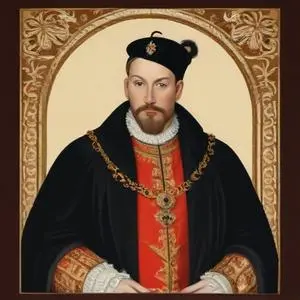
A powerful and charming favorite of Queen Elizabeth I, known for his influence on English politics and suspected involvement in the mysterious death of his wife.
Robert Dudley, 1st Earl of Leicester, was the paramount favourite of Queen Elizabeth I, a position he held from her accession in 1558 until his death in 1588. As a trusted statesman, he played a pivotal role in shaping England's domestic and foreign policies, earning him a reputation as one of the most influential figures of the Elizabethan era.
Born on June 24, 1532, Robert Dudley was the youngest son of John Dudley, 1st Duke of Northumberland. His family's downfall in 1553, resulting from his father's failed coup to prevent Mary I's accession, left Robert condemned to death. However, he was released in 1554 and went on to fight in the Battle of St. Quentin, where he was fully rehabilitated.
Upon Elizabeth I's accession in 1558, Dudley was appointed Master of the Horse, marking the beginning of his remarkable rise to prominence. He became a privy councillor in 1562 and was granted the title of Earl of Leicester in 1564, solidifying his position as a leading statesman. His influence extended to North Wales and the English West Midlands, where he became one of the largest landowners through royal grants.
As a member of Elizabeth's inner circle, Dudley was involved in both domestic and foreign policy-making. He worked closely with William Cecil and Sir Francis Walsingham to shape England's foreign policy, supporting the Dutch Revolt against Spanish rule. Although he initially sympathized with Mary, Queen of Scots, he later urged her execution, citing national security concerns.
Dudley was a patron of the Puritan movement, supporting nonconforming preachers and attempting to mediate between them and the Church of England. He also backed explorers and privateers, including Francis Drake, investing in his expeditions. During the Spanish Armada, Dudley was in overall command of the English land forces, inviting Queen Elizabeth to review the troops.
As an entrepreneur, Dudley was involved in numerous large-scale business ventures, including the establishment of the Muscovy Company and the development of the English cloth industry. However, his acceptance of the post of governor-general of the United Provinces led to a costly and unsuccessful expedition, ruining him financially.
Robert Dudley, 1st Earl of Leicester, left an indelible mark on English history, shaping the country's politics, religion, and economy. His legacy extends to his patronage of exploration, his support for the Puritan movement, and his role in securing England's position as a major world power.
"I am not of the mind to trouble the Queen with many words, but to show my dutifulness by my deeds."
Robert Dudley's impact on modern society is evident in his patronage of exploration, which contributed to England's rise as a major naval power. His support for the Puritan movement shaped the country's religious landscape, and his involvement in shaping England's foreign policy continues to influence international relations today.
As a prominent figure in Elizabethan England, Dudley's influence and reputation rivalled that of other leading statesmen, including William Cecil and Sir Francis Walsingham. His ability to navigate the complexities of court politics and foreign policy made him a unique and formidable figure in his time.
Born in 1533
The Virgin Queen, a powerful and beloved monarch, ruled England during a golden age of culture, literature, and exploration, establishing the Church of England and defeating the Spanish Armada.
Born in 1552
A Renaissance man who wrote poetry, fought in wars, and explored the New World, introducing potatoes and tobacco to England. He's famous for his daring exploits and romanticized legend.
