


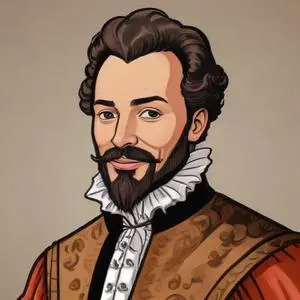
A Renaissance man who wrote poetry, fought in wars, and explored the New World, introducing potatoes and tobacco to England. He's famous for his daring exploits and romanticized legend.
Walter Raleigh, a name synonymous with bravery, adventure, and strategic brilliance, is renowned for his pivotal role in the English colonization of North America, his valiant efforts in suppressing rebellion in Ireland, and his instrumental contribution to defending England against the Spanish Armada.
As one of the most prominent figures of the Elizabethan era, Raleigh's life was a testament to his unwavering spirit, his passion for discovery, and his unrelenting commitment to serving his country.
Born around 1553 in Devon, England, Raleigh was the son of Walter Raleigh and Catherine Champernowne, and the younger half-brother of Sir Humphrey Gilbert and cousin of Sir Richard Grenville. His early life remains somewhat of a mystery, but it is known that he spent time in France during his late teens, participating in the religious civil wars.
In his 20s, Raleigh took part in the suppression of rebellion in Ireland, where he later became a landlord of property in Ireland and mayor of Youghal in east Munster. His house, Myrtle Grove, still stands today.
His bravery and strategic prowess caught the attention of Queen Elizabeth I, who knighted him in 1585. This marked the beginning of his meteoric rise to prominence, as he was granted a royal patent to explore Virginia, paving the way for future English settlements.
In 1594, Raleigh heard of a "City of Gold" in South America and set sail to find it. His expedition resulted in an exaggerated account of his experiences, which contributed to the legend of El Dorado.
Raleigh's quest for the City of Gold was not without controversy, as he led a second expedition in 1616, during which his men ransacked a Spanish outpost, violating the terms of his pardon and sparking tension with King James I.
Raleigh's personal life was marred by controversy, particularly his secret marriage to Elizabeth Throckmorton, one of the Queen's ladies-in-waiting, without her permission. This led to his imprisonment in the Tower of London, along with his wife.
After Queen Elizabeth's death in 1603, Raleigh's fortunes began to decline, and he was again imprisoned in the Tower for his alleged involvement in the Main Plot against King James I.
Walter Raleigh's legacy is complex and multifaceted, marked by his unwavering commitment to his country, his unrelenting passion for discovery, and his instrumental role in shaping the course of English history.
Despite controversy and setbacks, Raleigh's contributions to the Elizabethan era remain unparalleled, inspiring generations of explorers, statesmen, and scholars.
Walter Raleigh's life was a testament to his indomitable spirit, his bravery, and his unwavering commitment to his country. As we reflect on his legacy, we are reminded of the power of human ingenuity, the importance of exploration, and the enduring impact of one life on the course of history.
Born in 1564
Renowned playwright and poet behind iconic works like Romeo and Juliet, Hamlet, and Macbeth, whose writings continue to influence literature and theater to this day.
Born in 1564
A Renaissance master of words, crafting plays and poems that explored the human condition, and translating ancient texts into English, leaving a lasting impact on literature.
79 Years Old
Australian Labor Party politician who served as Treasurer of Australia from 1983 to 1991, implementing significant economic reforms. He is credited with modernizing the Australian economy.
Born in 1457
First Tudor king of England, who ended the Wars of the Roses and established a strong, centralized government, bringing stability and prosperity to the country.
Born in 1478
A renowned Renaissance humanist and statesman who served as Lord Chancellor of England, famous for his literary work "Utopia" and his martyrdom for refusing to acknowledge the English monarch's supremacy over the Church.
