


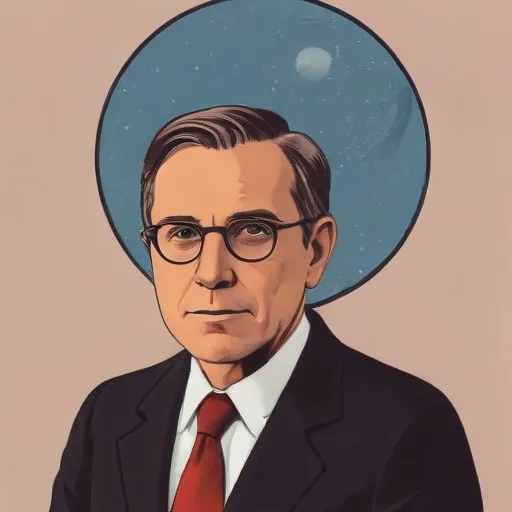
American astronomer and academic who made significant contributions to the field of astronomy, particularly in the discovery of double stars and binary systems.
Robert Grant Aitken is renowned for his groundbreaking work on double stars, cataloging over 3,100 new binary stars and revolutionizing the field of astronomy. Through his tireless efforts, Aitken enabled astronomers to calculate stellar mass statistics for a large number of stars, significantly advancing our understanding of the universe.
Aitken was born on December 31, 1864, in Jackson, California, to Scottish immigrant Robert Aitken and Wilhelmina Depinau. He attended Williams College in Massachusetts, graduating with an undergraduate degree in 1887. Aitken went on to receive his M.A. from Williams College in 1892, laying the foundation for his future success in astronomy.
Aitken's career was marked by a series of significant milestones, including his work as a mathematics instructor at Livermore, California, and his appointment as a professor of mathematics at the College of the Pacific. However, it was his position as an assistant astronomer at Lick Observatory in California, which he held from 1895, that truly showcased his talent and dedication.
During his time at Lick Observatory, Aitken collaborated with W. J. Hussey on a systematic study of double stars, measuring their positions and calculating their orbits. This partnership resulted in the creation of a vast catalog of such stars, with Aitken continuing the work alone after Hussey's departure in 1899.
Aitken's most notable achievement came in 1932 with the publication of the New General Catalogue of Double Stars Within 120° of the North Pole, a comprehensive catalog of double stars that included orbit information. This monumental work enabled astronomers to calculate stellar mass statistics for a large number of stars, cementing Aitken's status as a pioneer in the field.
In recognition of his outstanding contributions to astronomy, Aitken was awarded the prestigious Bruce Medal in 1926. He also served as president of the Astronomical Society of the Pacific in 1899 and 1915, and was an editor of the Publications of the Astronomical Society of the Pacific from 1898 to 1942.
Aitken's work on double stars has had a lasting impact on the field of astronomy, influencing generations of scientists and researchers. His dedication to cataloging and studying double stars has expanded our understanding of the universe, enabling astronomers to make more accurate calculations and predictions.
Aitken's legacy extends beyond his scientific contributions, inspiring future generations to pursue careers in astronomy and mathematics. His commitment to his craft serves as a testament to the power of dedication and hard work, making him a true pioneer in the field of astronomy.
In addition to his professional achievements, Aitken participated in an eclipse expedition to Flint Island in the central Pacific Ocean in 1908. He also published a book, Binary Stars, in 1918, with a second edition following in 1935.
Aitken's work on double stars reflects his deep fascination with the mysteries of the universe. His meticulous approach to cataloging and studying double stars demonstrates his commitment to understanding the underlying principles of the cosmos.
Through his work, Aitken has left a lasting legacy, inspiring future generations to continue exploring the wonders of the universe. His contributions to astronomy have deepened our understanding of the cosmos, paving the way for new discoveries and breakthroughs.
Born in 1885
Measured the galaxy's size and mapped the Milky Way's structure, revolutionizing our understanding of the universe.
Born in 1868
Founded the Mount Wilson Observatory, pioneered the field of astrophysics, and developed innovative telescopes, making groundbreaking discoveries about the sun and stars.
Born in 1855
Founded the Lowell Observatory in Arizona, where he studied Mars and predicted the existence of a planet beyond Neptune, later discovered as Pluto.
Born in 1829
Discovered the moons of Mars, Phobos and Deimos, and made significant contributions to astronomy, particularly in the field of celestial mechanics.
Born in 1835
Developed innovative astronomical tables and made significant contributions to the field of mathematics, particularly in the areas of celestial mechanics and economics.
