


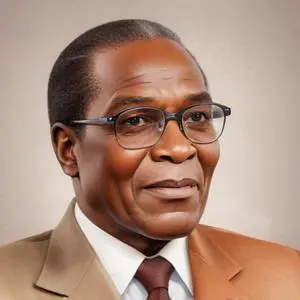
The 2nd President of Zimbabwe, a controversial figure who ruled with an iron fist, known for his country's economic downfall and human rights abuses.
Robert Gabriel Mugabe, the former Prime Minister and President of Zimbabwe, is arguably one of the most controversial figures in African politics, known for his complex and often contradictory legacy as a champion of African nationalism, a Marxist ideologue, and a leader who presided over a regime marked by human rights abuses, economic mismanagement, and authoritarianism.
Mugabe was born on February 21, 1924, in Kutama, Southern Rhodesia, to a poor Shona family. He received his early education at Kutama College and later attended the University of Fort Hare in South Africa, where he developed an interest in politics and became exposed to Marxist and nationalist ideologies. After completing his education, Mugabe worked as a schoolteacher in Southern Rhodesia, Northern Rhodesia, and Ghana, before becoming involved in politics full-time.
Mugabe's political career began in the 1960s, when he joined the African nationalist movement, advocating for an end to white minority rule in Southern Rhodesia. He was arrested and imprisoned from 1964 to 1974 for his anti-government activities. After his release, Mugabe fled to Mozambique, where he established his leadership of the Zimbabwe African National Union (ZANU) and played a key role in the Rhodesian Bush War against the white minority government of Ian Smith.
In 1979, Mugabe participated in the Lancaster House Agreement, which led to the country's independence in 1980. In the same year, he became the Prime Minister of Zimbabwe, a position he held until 1987, when he became the country's President.
During his presidency, Mugabe implemented a range of policies aimed at addressing the country's social and economic challenges. He expanded access to healthcare and education, and implemented land reform policies aimed at redistributing land from white farmers to black Zimbabweans.
However, Mugabe's presidency was also marked by authoritarianism, human rights abuses, and economic mismanagement. His government was criticized for its brutal suppression of political opponents, including the massacre of thousands of civilians in Matabeleland in the 1980s.
Robert Mugabe's legacy is complex and contested. While he is celebrated by some as a champion of African nationalism and a hero of the liberation struggle, others condemn him as a ruthless dictator who presided over a regime marked by human rights abuses and economic mismanagement.
Despite his many flaws, Mugabe played a significant role in shaping Zimbabwe's history and identity. His legacy continues to influence politics and society in Zimbabwe and beyond, serving as a reminder of the complexities and challenges of post-colonial Africa.
Mugabe was married to Sally Hayfron, a Ghanaian woman, from 1961 until her death in 1992. He later married Grace Marufu, a former secretary, and had several children with both wives.
Mugabe died on September 6, 2019, at the age of 95, after a long illness. His death marked the end of an era in Zimbabwean politics and sparked a period of reflection and debate about his legacy and impact.
Robert Mugabe's life and legacy must be understood within the context of Zimbabwe's complex and tumultuous history. His rise to power was shaped by the country's struggle for independence and the ongoing contestation for power and resources between black and white Zimbabweans.
As a polarizing figure, Mugabe's legacy will continue to be debated and contested for generations to come. However, his significance as a symbol of African nationalism and a champion of land reform and social justice cannot be denied.
74 Years Old
The first prime minister of Zimbabwe after independence from white minority rule, known for his efforts to bring democracy and economic reform to the country. He was a key figure in the fight against authoritarianism and human rights abuses.
Born in 1918
A South African lawyer and politician who fought against apartheid, becoming the country's first black president and a symbol of racial reconciliation, earning a Nobel Peace Prize. He's a beacon of hope and freedom.
84 Years Old
The second President of South Africa, a key figure in the country's transition from apartheid to democracy, known for his economic reforms and HIV/AIDS controversy.
89 Years Old
A Nigerian general and politician who served as the 5th President of Nigeria, known for his efforts to stabilize the country's economy and promote democracy. He's also known for his role in brokering peace in several African countries.
98 Years Old
The authoritarian leader who ruled Egypt for nearly three decades, suppressing opposition and maintaining a tight grip on power, while also maintaining a delicate balance of power in the Middle East. He's infamous for his regime's human rights abuses and corruption.
Born in 1924
First president of Zambia, leading the country to independence from British colonial rule and advocating for African unity and development.
Born in 1922
First President of Tanzania, led the country to independence from British colonial rule and implemented socialist policies, known for his Pan-Africanism and anti-colonialism efforts.
