


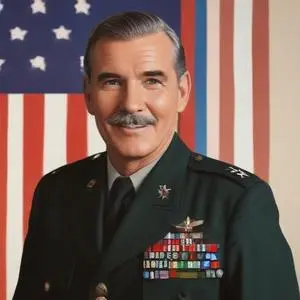
Led the 506th Parachute Infantry Regiment during World War II, earning a Distinguished Service Cross for bravery, and later commanded the 101st Airborne Division.
Robert Sink, a renowned United States Army officer, is most famous for his command of the 506th Parachute Infantry Regiment, part of the 101st Airborne Division, throughout most of World War II. He led his troops through fierce battles in France, the Netherlands, and Belgium, earning a reputation as a fearless and strategic commander.
Sink was born on April 3, 1905, and attended Duke University, then known as Trinity College, for one year before securing an appointment to the United States Military Academy. He graduated 174th in West Point's 203-member class of 1927, earning his commission as an Infantry officer.
Early in his career, Sink took assignments in Puerto Rico, the Army Chemical Warfare School, and Fort Meade, before attending the United States Army Infantry School at Fort Benning, Georgia in 1935. In November 1937, he was assigned to the 57th Infantry Regiment at Fort William McKinley in the Philippines, and later returned to the United States to serve as company commander and regimental operations officer at Fort Huachuca, Arizona.
In 1940, Sink was assigned to the 501st Parachute Infantry Battalion at Fort Benning, where he became one of the four percent of the Army's paratroopers qualified as a master parachutist. He celebrated his birthday each year by making another jump. Sink later commanded the 503rd Parachute Infantry Battalion and later Regiment, before being named as commander of the 506th Parachute Infantry Regiment at Camp Toccoa, Georgia in July 1942.
Sink commanded the 506th throughout World War II, turning down two promotions during his tenure. He led his troops through some of the war's most pivotal battles, including D-Day, Operation Market Garden, and the Battle of the Bulge. Under his leadership, the 506th earned a reputation as one of the most elite and feared units in the war.
Robert Sink's leadership and bravery during World War II left an indelible mark on the United States Army and the world. He was a true hero, whose selflessness and courage inspired generations of soldiers. Sink's legacy continues to be felt today, as the 506th Parachute Infantry Regiment remains one of the most revered units in the Army.
Sink's remarkable military career and legacy continue to inspire and educate people to this day, serving as a testament to his bravery, leadership, and selflessness.
Born in 1890
Led the Allied forces to victory in World War II and later served as President, maintaining peace and prosperity during the Cold War era. He's known for his strategic leadership and diplomatic skills.
Born in 1893
Led the US Army in World War II and became the last five-star general, playing a crucial role in shaping post-war American military strategy. He's also known for his humble and unassuming leadership style.
Born in 1885
A renowned military leader who played a crucial role in World War II, particularly in the Allied victory in Europe, known for his bold tactics and unapologetic style.
Born in 1880
A highly decorated war hero and master strategist who led troops to victory in World War I and II, and later became a prominent figure in the occupation of Japan.
Born in 1885
Led the U.S. Pacific Fleet to victory in World War II, playing a crucial role in defeating Japan and ending the war. He was a highly respected and decorated naval leader.
Born in 1895
Led the US Eighth Army to victory in the Korean War, credited with turning the tide of the conflict and earning a reputation as a skilled military strategist.
