


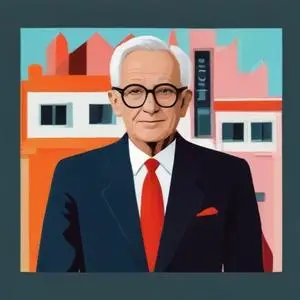
A pioneer of postmodern architecture, known for challenging modernist principles and incorporating historical references and irony into building designs.
Robert Venturi, the renowned American architect, is best known for his pioneering work in postmodern architecture, which dismissed the modernist concept of "less is more" and instead celebrated complexity, ambiguity, and historical references. His iconic designs, often characterized by bold colors, intricate patterns, and eclecticism, have left an indelible mark on the architectural landscape.
Venturi was born on June 25, 1925, in Philadelphia, Pennsylvania, to Robert Venturi Sr. and Vanna Luizi Venturi. Raised as a Quaker, he attended the Episcopal Academy in Merion, Pennsylvania, and later graduated summa cum laude from Princeton University in 1947. His time at Princeton, under the guidance of Professor Jean Labatut, played a significant role in shaping his approach to architectural theory and design.
In the 1960s, Venturi, along with his wife and partner Denise Scott Brown, challenged the dominance of modernist architecture with their groundbreaking book, Learning from Las Vegas (1972). This seminal work rejected the modernist notion of simplicity and functionality, instead embracing the ornate, the kitsch, and the ordinary. Their designs, which hybridized historical styles with commercial architecture, gave birth to postmodernism.
Venturi's contributions to architecture have been recognized with numerous awards, including the Pritzker Prize in Architecture (1991), the Gold Medal from the American Institute of Architects (2016), and the National Medal of Arts (2016).
Robert Venturi's work has not only expanded the discourse on architecture but also influenced generations of architects, planners, and students. His emphasis on historical references, complexity, and ambiguity has broadened the possibilities of architectural design. As Venturi once said, "I am for richness of meaning rather than clarity of meaning."
Venturi's work embodies a philosophy that celebrates the complexity and richness of human experience. He believed that architecture should engage with history, culture, and the human condition, rather than simply serving functional purposes. His ideas have challenged the conventional norms of modernist architecture, opening up new possibilities for design and expression.
We hope this article has provided a comprehensive understanding of Robert Venturi's life, work, and legacy. His pioneering spirit, philosophical contributions, and iconic designs have left an indelible mark on the world of architecture.
97 Years Old
A visionary architect and designer, known for his bold, expressive, and curvaceous structures that defy conventional norms, redefining urban landscapes and pushing the boundaries of art and architecture.
92 Years Old
A renowned architect celebrated for his postmodern designs, blending historical references with modern functionality, creating iconic buildings that redefine urban landscapes.
94 Years Old
Designed iconic, deconstructivist buildings that challenge traditional notions of architecture, blending art and functionality. His structures often spark controversy and intellectual debate.
81 Years Old
A renowned architect and academic who designed iconic buildings like the Seattle Central Library, blending functionality with innovative design.
75 Years Old
A pioneering female architect who revolutionized building design with futuristic, curvaceous structures, pushing the boundaries of innovation and aesthetics.
Born in 1867
Visionary architect behind iconic, harmonious structures that blend seamlessly into their surroundings, redefining modern American architecture.
Born in 1887
A pioneer of modern architecture, famous for designing innovative, functional, and visually striking buildings that transformed urban landscapes. His works continue to inspire architects and designers worldwide.
