


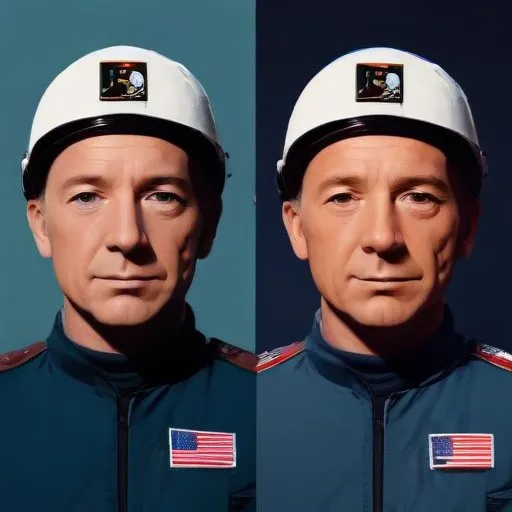
Astronaut and engineer who flew on the Apollo 1 mission, tragically killed in a fire during a ground test, remembered for his bravery and sacrifice in the pursuit of space exploration.
Roger B. Chaffee, an American naval officer, aviator, and aeronautical engineer, is best known for his heroic service as a NASA astronaut in the Apollo program. His bravery and dedication to the exploration of space left an indelible mark on the world, making him an iconic figure in the history of space travel.
Born on February 15, 1935, in Grand Rapids, Michigan, Chaffee grew up with a passion for flight and adventure. As an Eagle Scout, he developed strong leadership skills and a sense of community, which would later serve him well in his military and astronaut career. After graduating from Central High School in 1953, Chaffee accepted a Naval Reserve Officers Training Corps (NROTC) scholarship and began his college education at Illinois Institute of Technology.
Chaffee transferred to Purdue University in 1954, where he continued to excel academically and became involved in the fraternity Phi Kappa Sigma, serving as chapter president in 1956. During his time at Purdue, he also obtained his private pilot's license, a testament to his unwavering enthusiasm for aviation.
After graduating from Purdue in 1957 with a Bachelor of Science degree in Aeronautical Engineering, Chaffee completed his Navy training and was commissioned as an ensign. He began pilot training at Naval Air Station Pensacola, Florida, flying aircraft such as the T34, T28, and A3D. His time in the Navy included a stint as quality and safety control officer for Heavy Photographic Squadron 62 (VAP-62), during which he took crucial photos of Cuba during the Cuban Missile Crisis, earning him the Air Medal.
In 1963, Chaffee was selected as an astronaut as part of NASA Astronaut Group 3, alongside 13 other talented pilots. He served as capsule communicator (CAPCOM) for the Gemini 3 and Gemini 4 missions, providing critical support to the astronauts during their spaceflights.
In 1966, Chaffee received his first spaceflight assignment as the third-ranking pilot on Apollo 1, a mission that tragically ended in a fire during a prelaunch test at Cape Kennedy Air Force Station Launch Complex 34, Florida, on January 27, 1967. Chaffee's bravery and sacrifice, along with those of fellow astronauts Virgil "Gus" Grissom and Ed White, will never be forgotten.
In recognition of his exceptional service and sacrifice, Chaffee was posthumously awarded the Congressional Space Medal of Honor and a second Air Medal. His legacy continues to inspire generations of space enthusiasts, military personnel, and individuals from all walks of life.
Chaffee's story serves as a poignant reminder of the risks and sacrifices made by those who push the boundaries of human exploration. His courage, dedication, and unwavering commitment to the pursuit of excellence will forever be etched in the annals of history.
"The universe is not only much stranger than we think, it is stranger than we can think." - Roger B. Chaffee
This quote, often attributed to Chaffee, reflects his deep fascination with the mysteries of the universe and his boundless enthusiasm for exploration. It serves as a testament to the enduring spirit of discovery that drove him to greatness.
Roger B. Chaffee's legacy extends far beyond his own achievements. His contributions to the Apollo program helped pave the way for future space exploration and have inspired countless individuals to pursue careers in science, technology, engineering, and mathematics (STEM).
Chaffee's story has also had a profound impact on the families of astronauts and military personnel, serving as a poignant reminder of the sacrifices made by those who serve their country and push the boundaries of human achievement.
In conclusion, Roger B. Chaffee's life was a testament to courage, dedication, and the unwavering pursuit of excellence. His legacy will continue to inspire and educate generations to come, serving as a beacon of hope and a reminder of the boundless potential of the human spirit.
Born in 1926
One of the original seven astronauts in NASA's Project Mercury, a decorated military pilot, and a pioneer in space exploration, known for being the second American in space and commanding the first manned Gemini mission.
95 Years Old
First American to walk in space, performing a 21-minute extravehicular activity during the Gemini 4 mission in 1965.
96 Years Old
First person to walk on the Moon during the Apollo 11 mission, marking a historic milestone in space exploration.
96 Years Old
Second man to walk on the Moon during the Apollo 11 mission, a pioneering astronaut and advocate for space exploration.
96 Years Old
Led the third manned mission to land on the Moon, Apollo 12, and became the third person to walk on its surface. Known for his bold and fearless approach to space exploration.
94 Years Old
One of the 12 humans to walk on the Moon during NASA's Apollo program, known for his moonwalk during Apollo 12 and later becoming a painter, capturing the beauty of space through art.
98 Years Old
Commander of the Apollo 13 mission, known for his heroic efforts in saving his crew after an explosion occurred on board. He's an iconic figure in space exploration history.
94 Years Old
Astronaut and pilot who flew on Apollo 13, famously uttering "Houston, we've had a problem" during the mission's critical malfunction. He played a crucial role in saving the crew from disaster.
