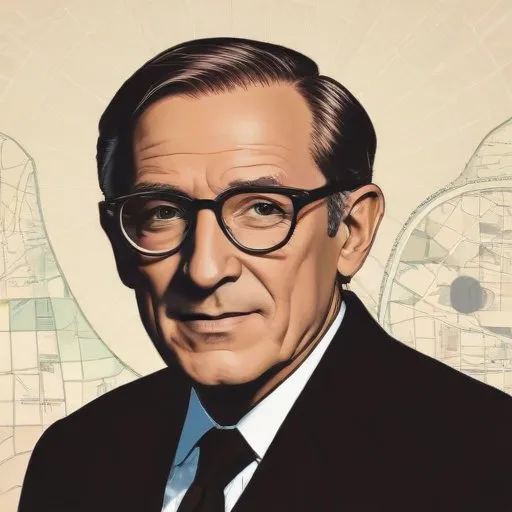
Roger L. Easton

Roger L. Easton

Roger L. Easton was born on April 30th, 1921

Full Name: Roger Lee Easton
Nationality: American
Profession: Scientist, Engineer
Field: GPS technology
Birth Date: April 30, 1921
Death Date: March 8, 2014
Awards: National Medal of Technology
Notable Work: GPS Satellites

Co-creator of the Global Positioning System (GPS), a network of satellites providing location information and precise timing, revolutionizing navigation and countless industries.

Written by: Victor Malone Victor Malone

Roger L. Easton: The Visionary Behind GPS

Roger L. Easton, a physicist and state representative, is renowned for his pioneering work in developing the Global Positioning System (GPS). Alongside Ivan A. Getting and Bradford Parkinson, Easton played a pivotal role in designing and inventing the GPS technology that has revolutionized navigation and transformed the way we live.

Career Highlights

Easton's remarkable career began in 1955 when he co-wrote the Naval Research Laboratory's Project Vanguard proposal for a U.S. satellite program. This proposal, selected by the Eisenhower Administration, marked the beginning of Easton's involvement in satellite technology.

The Birth of GPS

In the 1960s and early 1970s, Easton conceived, patented, and led the development of essential enabling technologies for the United States Global Positioning System (GPS). His innovative approach involved a time-based navigational system with passive ranging, circular orbits, and spaceborne high-precision clocks placed in satellites.

The idea was tested with four experimental satellites:

NTS-2, launched in 1977, was the first satellite to transmit GPS signals, paving the way for the modern GPS system we use today.

Personal Life

Roger L. Easton was born on April 30, 1921, in Craftsbury, Vermont, to Dr. Frank B. Easton, a physician, and Della Donnocker, a school teacher. He studied physics at Middlebury College, graduating in 1943, and later attended the University of Michigan for one semester before joining the Naval Research Laboratory in 1943.

Legacy

Roger L. Easton's groundbreaking contributions to GPS technology have had a profound impact on modern society. His work has enabled accurate navigation, improved logistics, and transformed the way we travel. As a testament to his vision and ingenuity, Easton's legacy continues to inspire new generations of innovators and engineers.

Easton's remarkable career serves as a reminder that human ingenuity and perseverance can lead to incredible breakthroughs, shaping the course of human history.

Timeline
1921
Born in Milford, New Hampshire
Roger Easton was born on April 30, 1921, in Milford, New Hampshire, USA.
1950
Joined the US Navy as an Engineer
Easton began his career as an engineer in the US Navy, working on various projects including the development of satellite navigation systems.
1972
Developed the First GPS Satellite
Easton led the team that developed the first GPS satellite, paving the way for the modern Global Positioning System.
1993
Retired from the US Navy
Easton retired from the US Navy after a distinguished career, having made significant contributions to the development of GPS technology.
2014
Died in Washington, D.C.
Roger Easton passed away on May 8, 2014, leaving behind a legacy as a pioneering engineer and innovator in the field of GPS technology.
Roger L. Easton

Roger L. Easton Quiz

What is Roger L. Easton credited with co-creating?

Score: 0/5
FAQ
Who is the inventor of the GPS system?
Roger L. Easton, an American scientist, is credited with co-inventing the Global Positioning System (GPS) technology. His innovative work led to the development of the first GPS satellite, which was launched in 1978.
What is Roger L. Eastons contribution to the development of GPS?
Eastons contribution included the design of the first GPS satellite, which was capable of transmitting radio signals that could be received by GPS receivers on the ground. He also developed the timing and synchronization system for the GPS network.
What awards did Roger L. Easton win for his work on GPS?
Easton received the National Medal of Technology, the Draper Prize, and the NASA Distinguished Service Medal for his pioneering work on GPS technology.
How did Roger L. Eastons work on GPS impact the world?
Eastons work on GPS has had a profound impact on various fields, including aviation, navigation, and geolocation. GPS technology has enabled accurate and efficient navigation, improved logistics, and enhanced military operations.
What is Roger L. Eastons legacy in the field of science?
Eastons legacy is that of a pioneering scientist who has made significant contributions to the development of GPS technology. His work has paved the way for future breakthroughs in navigation, surveillance, and communication systems.

Related People:

Bradford Parkinson

91 Years Old

Developed the Global Positioning System (GPS), revolutionizing navigation and mapping, and led the team that launched the first GPS satellite in 1978.