


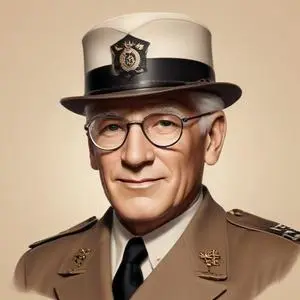
Developed the Global Positioning System (GPS), revolutionizing navigation and mapping, and led the team that launched the first GPS satellite in 1978.
Bradford Parkinson is synonymous with innovation and precision, best known as the lead architect, advocate, and developer of the Air Force's NAVSTAR program, famously known as the Global Positioning System (GPS). This pioneering engineer has left an indelible mark on modern technology, revolutionizing the way we navigate and understand our world.
Born on February 16, 1935, Parkinson's journey began with a strong foundation in education. He attended the Breck School, a small, all-boys preparatory school, where he developed a passion for mathematics and science. This early fascination ultimately led him to enroll in the United States Naval Academy, graduating in 1957 with a Bachelor of Science in Engineering.
Parkinson's interest in controls engineering was sparked during his senior year at the Naval Academy. His professor, an Air Force officer, encouraged him to consider being commissioned in the Air Force rather than the Navy, which proved to be a pivotal decision. The Air Force offered more opportunities for graduate and postgraduate education, allowing Parkinson to pursue his Ph.D. ambitions.
Commissioned in the Air Force, Parkinson was trained in electronics maintenance and supervised large ground radar installations. His military career spanned over two decades, during which he worked on various projects, including the development of the Gravity Probe B, which tested gravitomagnetism and was the first direct mechanical test of Einstein's General Relativity.
In the 1970s, Parkinson became the driving force behind the NAVSTAR program, working closely with Ivan Getting and Roger Easton. Their groundbreaking collaboration led to the development of the first GPS satellite, launched in 1978. Over the years, Parkinson continued to refine the system, ensuring its accuracy and reliability.
Parkinson's contributions have far-reaching implications, transforming industries such as aviation, maritime, and agriculture. The GPS system has become an integral part of modern life, with applications in emergency services, navigation, and exploration.
As an Emeritus Professor at Stanford University, Parkinson has inspired generations of engineers and scientists. His work on GPS has paved the way for future innovators, solidifying his place in the annals of history as a true pioneer in the field of engineering.
Today, Bradford Parkinson's legacy continues to shape our understanding of the world, his work a testament to the power of human ingenuity and the boundless potential of the human mind.
95 Years Old
First person to walk on the Moon during the Apollo 11 mission, marking a historic milestone in space exploration.
96 Years Old
Second man to walk on the Moon during the Apollo 11 mission, a pioneering astronaut and advocate for space exploration.
96 Years Old
Led the third manned mission to land on the Moon, Apollo 12, and became the third person to walk on its surface. Known for his bold and fearless approach to space exploration.
97 Years Old
Co-founder of Intel Corporation, revolutionized the tech industry with his prediction that the number of transistors on a microchip would double about every two years, leading to exponential growth in computing power and reductions in cost.
Born in 1912
Developed the V-2 rocket for Nazi Germany and later led the team that created the Saturn V rocket that took humans to the moon.
