


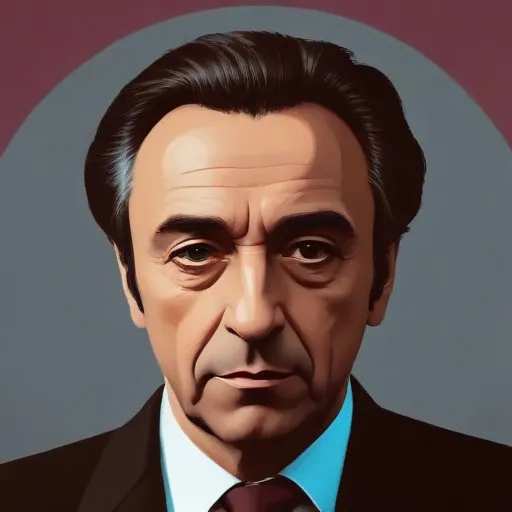
A French Renaissance man who excelled in multiple fields, including literature, diplomacy, filmmaking, and aviation, leaving a lasting impact on 20th-century culture.
Romain Gary, a French novelist, diplomat, film director, and World War II aviator, left an indelible mark on French literature in the second half of the 20th century. He is the only author to have won the prestigious Prix Goncourt under two names – Romain Gary and Émile Ajar – a testament to his remarkable versatility and creativity.
Born Roman Kacew in 1914 in Vilnius, then part of the Russian Empire, Gary's early life was marked by instability and upheaval. His parents, Mina Owczyska and Arieh-Leib Kacew, were both Lithuanian Jews who divorced in 1925. Gary later claimed that his biological father was the celebrated actor and film star Ivan Mosjoukine, with whom his actress mother had worked.
Gary's journey to becoming a writer was circuitous, to say the least. He studied law in Aix-en-Provence and Paris, before learning to pilot an aircraft in the French Air Force. However, despite completing his course successfully, he was denied a commission due to his foreign and Jewish heritage. This experience of rejection would later inform his writing, which often explored themes of identity, belonging, and the human condition.
Gary's career as a diplomat spanned several decades, during which he served as a French consul in Bulgaria and later as a chargé d'affaires in Switzerland. However, it was his writing that truly set him apart. Under his own name, Romain Gary, he penned novels like The Roots of Heaven, which won the Prix Goncourt in 1956. As Émile Ajar, he wrote , which won the same prize in 1975, becoming the only author to achieve this feat.
In addition to his literary pursuits, Gary also made a name for himself in the world of film and aviation. He wrote and directed several films, including Birds in Peru, and was a decorated aviator, flying combat missions during World War II.
Gary's personal life was marked by two high-profile marriages, first to Lesley Blanch and then to Jean Seberg. He died in 1980, leaving behind a body of work that continues to captivate readers and inspire writers around the world.
Romain Gary's remarkable life and career serve as a testament to the power of creativity and determination. A true Renaissance man, he continues to inspire generations of writers, filmmakers, and thinkers around the world.
Born in 1905
Existentialist philosopher and playwright who argued that humans have complete freedom to choose their actions and create their own meaning in life, influencing modern thought on morality and individual responsibility.
Born in 1908
A pioneering feminist philosopher who wrote extensively on ethics, politics, and gender, famously arguing that "one is not born, but rather becomes, a woman."
Born in 1913
A French novelist, philosopher, and journalist who wrote influential works like "The Stranger" and "The Plague", exploring absurdism and the human condition.
Born in 1901
A French historian, theorist, and author who wrote influential novels and essays on art, politics, and human condition, exploring the complexities of modern society.
Born in 1897
A leading figure of the French Resistance during WWII, he wrote influential poetry and novels that explored the human condition, blending politics and art.
Born in 1889
A renowned French creative force, celebrated for his innovative and surreal works that blurred the lines between literature, art, and cinema, leaving an indelible mark on 20th-century culture.
Born in 1869
A pioneering artist who revolutionized modern art with bold, expressive, and colorful works that blurred the lines between painting and sculpture, creating a new language of form and color.
Born in 1881
A pioneering artist who transformed modern art with pioneering Cubist works, creating a new visual language that continues to inspire and influence art, design, and culture.
