


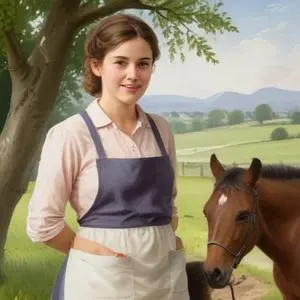
A pioneering female artist who broke gender barriers, creating powerful and realistic depictions of animals, particularly horses, that captivated the art world. Her work continues to inspire and influence wildlife art today.
Rosa Bonheur, a French artist born Marie Rosalie Bonheur, is renowned for her exceptional talent in painting and sculpting animals in a realist style. Her masterpieces, including Ploughing in the Nivernais and The Horse Fair, have cemented her position as one of the most celebrated female artists of the 19th century.
Born on March 16, 1822, in Bordeaux, France, Rosa Bonheur was the oldest child in a family of artists. Her mother, Sophie Bonheur née Marquis, was a piano teacher, and her father, Oscar-Raymond Bonheur, was a landscape and portrait painter who encouraged his daughters' artistic talents. The Bonheur family adhered to Saint-Simonianism, a Christian socialist sect that promoted the education of women alongside men.
When Rosa was just six years old, her family moved to Paris, where she was exposed to the art world and began her artistic training. Her mother taught her to read and write, and she would spend hours sketching with pencil and paper. Rosa's siblings, including Auguste, Juliette, and Isidore Jules Bonheur, were also artists, and Francis Galton would later use the Bonheurs as an example of hereditary genius in his 1869 essay.
Rosa Bonheur's artistic career was marked by her unparalleled talent in capturing the essence of animals. Her paintings, characterized by their precision and attention to detail, showcased her deep understanding of animal anatomy and behavior.
Rosa Bonheur's personal life was marked by her unconventional relationships and independent spirit. She lived with her partner, Nathalie Micas, for over 40 years until Micas' death, and later lived with American painter Anna Elizabeth Klumpke.
Rosa Bonheur's contributions to the art world extended beyond her remarkable paintings. She paved the way for future generations of female artists, inspiring them to pursue careers in the male-dominated art world.
Today, Bonheur's works continue to captivate art enthusiasts around the world. Her paintings are held in high esteem, and her legacy as a trailblazing female artist remains unwavering.
Rosa Bonheur's artistic philosophy was rooted in her commitment to realism and her passion for animals. Her art was not only a reflection of her exceptional talent but also a testament to her dedication to capturing the beauty and complexity of the natural world.
Rosa Bonheur's remarkable career unfolded during a time when women were largely excluded from the art world. Despite these obstacles, she navigated the male-dominated art scene with grace and determination, earning the respect and admiration of her contemporaries.
In comparison to her contemporaries, Bonheur's artistic style was unique, marked by her unwavering commitment to realism and her exceptional talent in capturing the intricacies of animal anatomy and behavior.
Rosa Bonheur's personal relationships and unconventional lifestyle have sparked controversy and speculation among art historians and enthusiasts. While her relationships have been subject to interpretation, her artistic talent and contributions to the art world remain uncontestable.
"My brush is not a seducer, it is a revealer." - Rosa Bonheur
Rosa Bonheur's legacy extends beyond her remarkable paintings to her influence on art education. She paved the way for future generations of female artists, inspiring them to pursue careers in the art world.
Her contributions to art education have been recognized and celebrated, solidifying her position as a pioneering figure in the art world.
Born in 1791
A Romantic-era master of dramatic and emotionally charged art, known for his powerful depictions of horses and the human experience.
Born in 1798
A Romantic-era master of expressive brushstrokes and vivid color, creating iconic works that captured the drama and emotion of historical and literary scenes.
Born in 1746
A visionary artist who pioneered Romanticism, capturing the human experience through bold, emotionally charged paintings and sculptures that continue to inspire and unsettle.
Born in 1780
A renowned French Neoclassicist painter and illustrator, celebrated for his exquisite portraits and historical scenes that epitomize elegance and refinement. His work continues to inspire artists and art enthusiasts alike.
Born in 1827
A French painter celebrated for his poignant and intimate depictions of rural life, capturing the beauty and hardship of peasant women in their daily routines.
Born in 1819
A pioneer of Realism, this artist rejected idealized representations, instead depicting everyday life and people in a raw, unromanticized manner, influencing the development of modern art.
47 Years Old
A Belgian goalkeeper who played for several clubs, including Bologna and Torino, and is known for his impressive saves and penalty-stopping abilities.
Born in 1830
A Danish-French Impressionist painter who captured the beauty of landscapes and cityscapes with vivid colors and bold brushstrokes, influencing the development of modern art.
