


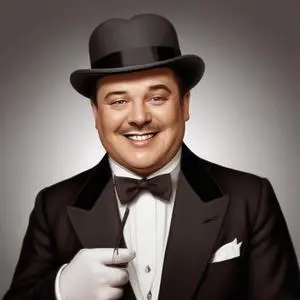
A silent film star who charmed audiences with his comedic talents, directing and writing skills, and is infamous for a scandal that tarnished his reputation.
Roscoe Arbuckle, known affectionately as "Fatty," was a pioneering silent film actor, director, and screenwriter who dominated the silver screen in the 1910s. With his impressive physique, impressive comedic timing, and kind heart, Arbuckle became one of the most beloved and highest-paid actors in Hollywood, signing a contract with Paramount Pictures for a staggering $1 million a year (equivalent to $15.2 million in 2023).
Born on March 24, 1887, in Smith Center, Kansas, Arbuckle began his career in vaudeville, performing in various stage shows and eventually making his way to the Selig Polyscope Company. He soon moved to Keystone Studios, where he worked alongside Mabel Normand, Harold Lloyd, and his nephew, Al St. John. It was during this time that Arbuckle mentored some of the biggest names in comedy, including Charlie Chaplin, Monty Banks, and Bob Hope.
Arbuckle's talents didn't go unnoticed for long. He became one of the most popular silent stars of the 1910s, known for his gentle giant persona and hilarious antics. His success allowed him to bring vaudeville star Buster Keaton into the movie business, and he continued to support up-and-coming comedians throughout his career. Arbuckle's kindness extended beyond the film industry, too; he was known for his charitable work, often performing at benefits and donating to worthy causes.
In 1921, Arbuckle's life took a dramatic turn when he was accused of raping and accidentally killing actress Virginia Rappe at a party in San Francisco's St. Francis Hotel. The highly publicized trials that followed resulted in two hung juries and one acquittal, but the damage had already been done. Despite his acquittal, the scandal led to Arbuckle's public ostracism and the banning of his films by motion picture industry censor Will H. Hays.
Although the scandal overshadowed his legacy, Arbuckle's contributions to the world of comedy cannot be ignored. He continued to work in the film industry, directing and writing under pseudonyms to avoid controversy. In the 1930s, Arbuckle began to make a comeback, eventually winning over audiences once again with his talent and charm. In 1932, he was finally able to speak publicly about the scandal, stating, "I was guilty of two things: I was guilty of being a fool, and I was guilty of being a gentleman."
Roscoe Arbuckle's story is a testament to the power of resilience and redemption. Despite the challenges he faced, he remained dedicated to his craft and continued to bring joy to audiences around the world. As we look back on his remarkable career, we are reminded of the importance of kindness, compassion, and the enduring legacy of a true silent film legend.
Born in 1889
A pioneer of silent film, he is renowned for his iconic "Little Tramp" character and groundbreaking work in writing, directing, and starring in his own movies.
Born in 1893
Pioneering silent film star and stunt master, known for performing daring physical comedy and iconic scenes, such as hanging from a clock tower.
Born in 1895
A pioneering silent film comedian, known for his deadpan expression and ingenious physical comedy, who wrote, directed, and starred in his own films.
Born in 1892
A pioneering actress, producer, and screenwriter who co-founded United Artists, revolutionizing the film industry with her creative vision and business acumen. She was a silent film star and one of the most popular actresses of her time.
Born in 1883
A swashbuckling pioneer of silent films, known for his daring stunts and charming on-screen presence, revolutionizing the action-adventure genre.
Born in 1895
Silent film star and muse to Charlie Chaplin, known for her charming on-screen presence and iconic roles in films like "City Lights" and "The Gold Rush".
