


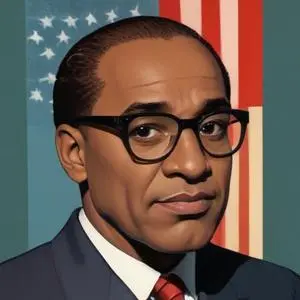
Leading figure in the Civil Rights Movement, advocating for racial equality and social justice through his writing and leadership in the NAACP.
Roy Ottoway Wilkins was a renowned American civil rights leader who spearheaded the movement from the 1930s to the 1970s. As the Executive Secretary and Executive Director of the National Association for the Advancement of Colored People (NAACP), Wilkins played a pivotal role in shaping the course of the civil rights movement, advocating for African American rights and equality.
Wilkins was born on August 30, 1901, in St. Louis, Missouri, to a father who fled the town to avoid lynching after refusing to yield the sidewalk to a white man. After his mother's death from tuberculosis when he was just four years old, Wilkins was raised by an aunt and uncle in the Rondo neighborhood of Saint Paul, Minnesota.
Wilkins graduated from Mechanic Arts High School and went on to earn a degree in sociology from the University of Minnesota in 1923. During his college years, he worked as a journalist at The Minnesota Daily and became editor of The Appeal, an African American newspaper.
In 1929, Wilkins married social worker Aminda Minnie Badeau, and the couple moved to New York City, where he became the assistant NAACP secretary under Walter Francis White. After W.E.B. Du Bois left the organization in 1934, Wilkins replaced him as editor of The Crisis, the official magazine of the NAACP.
In 1949-1950, Wilkins chaired the National Emergency Civil Rights Mobilization, further solidifying his position as a prominent figure in the civil rights movement. His leadership and advocacy were instrumental in shaping the NAACP's agenda and strategy during this period.
Wilkins' most notable role was his leadership of the NAACP, which he held from 1955 to 1963 as Executive Secretary and from 1964 to 1977 as Executive Director. During his tenure, he played a central role in many notable marches and protests, including the March on Washington for Jobs and Freedom in 1963, where Martin Luther King Jr. delivered his famous "I Have a Dream" speech.
Wilkins was a strong advocate for African Americans to join the military, a stance that sparked controversy within the civil rights movement. Despite this, he remained a key figure in the movement, working closely with other prominent leaders, including Martin Luther King Jr. and Whitney Young.
Roy Wilkins' legacy is multifaceted and far-reaching. He was a prolific writer and editor, making significant contributions to African American literature. His leadership and advocacy helped shape the civil rights movement, influencing generations of activists and leaders.
Throughout his career, Wilkins received numerous awards and honors, including the NAACP's Spingarn Medal in 1964. He continued to work for civil rights until his death on September 8, 1981, leaving behind a legacy that continues to inspire and motivate people to this day.
97 Years Old
A prominent leader in the civil rights movement, advocating for racial equality and social justice through nonviolent means, leaving a lasting impact on American history.
Born in 1926
A prominent leader in the American Civil Rights Movement, he worked closely with Martin Luther King Jr. to advocate for racial equality and social justice through nonviolent means.
Born in 1912
A pioneering civil rights activist who played a key role in organizing the 1963 March on Washington, where Martin Luther King Jr. delivered his iconic "I Have a Dream" speech.
94 Years Old
A prominent civil rights leader and diplomat who served as a key advisor to Martin Luther King Jr. and later became the first African American to hold a top post in an American presidential administration.
86 Years Old
A prominent civil rights leader and vocal advocate for social justice, known for his work as a founding member of the Student Nonviolent Coordinating Committee (SNCC) and his long tenure in the Georgia State Legislature.
85 Years Old
A prominent figure in the Civil Rights Movement, advocating for Black Power and self-defense, and famously coining the term "Black Power" in 1966. Known for his radical approach to achieving racial equality.
Born in 1925
A prominent figure in the Civil Rights Movement, advocating for African American rights and self-defense, and a powerful orator who inspired a generation.
Born in 1889
Leader of the Brotherhood of Sleeping Car Porters, pioneering the Civil Rights Movement through nonviolent protests and advocacy for African American workers' rights.
