


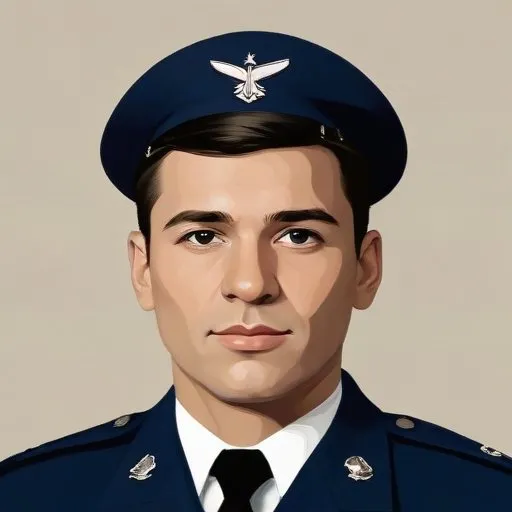
A U-2 spy plane pilot who was shot down and killed during the Cuban Missile Crisis, leading to a nearly catastrophic escalation of the Cold War.
Rudolf Anderson Jr. is etched in American history as the first recipient of the Air Force Cross, the U.S. military's and Air Force's second-highest award and decoration for valor. His name is synonymous with bravery and sacrifice, as he gave his life during the Cuban Missile Crisis, becoming the only U.S. fatality by enemy fire during this pivotal event.
Rudolf Anderson was born on September 15, 1927, in Spartanburg, South Carolina, near Greenville. He grew up with a strong sense of community and values, earning the rank of Eagle Scout from Boy Scout Troop 19 in Greenville. Anderson was a member of Recovery Lodge No. 31, Greenville's oldest Masonic Lodge, demonstrating his commitment to serving others.
After graduating from Augusta Circle Elementary School in Greenville, Anderson attended Greenville High School, graduating in 1944. He then pursued a Bachelor of Science degree in Textile Engineering from Clemson University in Clemson, South Carolina, where he was a member of Air Force ROTC Detachment 770. Following his graduation in 1948, Anderson spent three years working in Greenville before answering the call to serve his country.
In November 1951, during the Korean War, Anderson entered the Air Force, driven by a sense of duty and patriotism. Commissioned as a Second Lieutenant in 1952, he completed Primary and Advanced pilot training, receiving his U.S. Air Force aeronautical rating as a pilot. Anderson earned his pilot wings in February 1953 and began his operational career flying RF-86 Sabres.
Anderson's exceptional skills as a reconnaissance pilot earned him two Distinguished Flying Crosses for missions flown during the Korean War. Following the war, he was assigned to the 15th Tactical Reconnaissance Squadron at Kunsan Air Base in South Korea and flew missions out of Komaki Air Base in Japan. In April 1955, Anderson returned to the United States, where he would continue to distinguish himself as a top pilot.
In September 1957, Anderson qualified on the U-2, becoming the 4080th Strategic Reconnaissance Wing's top U-2 pilot with over one thousand hours. This expertise made him an integral part of the United States reconnaissance operation over Cuba in late October 1962, during the height of the Cuban Missile Crisis.
On October 27, 1962, Anderson's U-2 reconnaissance aircraft was shot down over Cuba, resulting in his death. This tragic event marked the only U.S. fatality by enemy fire during the Cuban Missile Crisis, and Anderson's ultimate sacrifice solidified his place as a national hero.
Rudolf Anderson's bravery and selflessness have been recognized with the highest honors. He posthumously received the Air Force Cross, the nation's second-highest award for valor, and was laid to rest in the Arlington National Cemetery.
Today, Anderson's legacy inspires generations of Americans, serving as a testament to the unwavering commitment of those who serve in the United States military. His story is a powerful reminder of the importance of courage, sacrifice, and duty, and his memory will continue to be revered for generations to come.
97 Years Old
A U-2 spy plane pilot who was shot down over the Soviet Union in 1960, leading to a major Cold War incident. He was later exchanged for a Soviet spy in a dramatic prisoner swap.
Born in 1894
The Soviet leader who initiated reforms and denounced Stalin's regime, known for his bold policies and iconic shoe-banging incident at the UN.
Born in 1917
The 35th President of the United States was a charismatic leader who navigated the country through the Cuban Missile Crisis and advocated for civil rights, leaving a lasting legacy in American politics.
Born in 1925
A Navy officer, lawyer, and politician who served as US Attorney General, playing a key role in the Civil Rights Movement and advocating for social justice. He was a prominent figure in American politics during the 1960s.
Born in 1835
The 23rd Vice President of the United States was a skilled lawyer and politician who served under President Grover Cleveland from 1893 to 1897, known for his strong oratory skills and progressive policies. He played a key role in shaping the country's foreign policy during his tenure.
Born in 1908
A zealous anti-communist who led a crusade against alleged communist infiltration in the US government, sparking a wave of paranoia and witch hunts in the 1950s.
Born in 1893
The 5th Director of Central Intelligence was a master spy and diplomat who oversaw the CIA during the Cold War, orchestrating covert operations and shaping global politics. He's infamous for his role in the Bay of Pigs invasion and CIA-led coups.
