


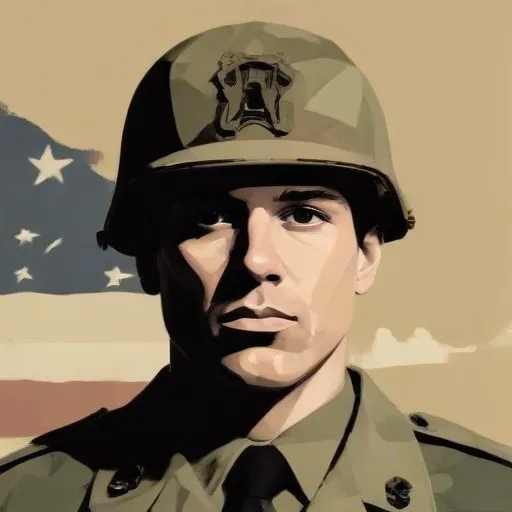
An American soldier and author who wrote about his experiences in World War I, particularly in the trenches of France, providing a firsthand account of the war's brutality. His writings offer a unique perspective on the human cost of conflict.
Russell Reeder, a United States Army officer, writer, and decorated war hero, left an indelible mark on American history. Born on March 4, 1902, at Fort Leavenworth, Kansas, Reeder's life was a testament to courage, perseverance, and literary prowess.
Reeder's early life was marked by frequent relocations, as his father, Russell Potter Reeder, Sr., was an officer in the United States Army. This nomadic lifestyle did not hinder Reeder's sense of responsibility, as evident from his heroic act at the age of eleven, when he saved the life of a drowning child in Casco Bay, Maine. This bravery earned him the Treasury Department Silver Lifesaving Medal in August 1913.
Reeder's military career took off when he entered the United States Military Academy at West Point, New York, in June 1920. He graduated as a member of the Class of 1926, despite two leaves of absence, and went on to serve in various capacities, including as a commander of the 12th Infantry Regiment within the Fourth Infantry Division during World War II.
Reeder's most notable contribution to American history came during World War II. On June 11, 1944, during the Battle of Normandy, Reeder received a shrapnel wound in his ankle that almost severed his left leg. This devastating injury did not break his spirit, and he continued to serve his country, eventually preparing a staff study that led to the creation of the Bronze Star Medal by President Franklin D. Roosevelt in February 1944.
Apart from his military accomplishments, Reeder was an accomplished writer, having authored the book Born at Reveille, which chronicles his army upbringing and experiences. His literary work provides a unique glimpse into the life of a military officer and his contributions to American history.
In 1934, Reeder married Dorothea Darrah, with whom he shared a life filled with love, duty, and service to the nation. His life was marked by numerous milestones, including his graduation from West Point, his appointment as a commander, and his eventual retirement from the army.
Russell Reeder's legacy extends beyond his military and literary achievements. He inspired a generation of Americans with his unwavering commitment to duty and country. His heroic acts, both on and off the battlefield, serve as a testament to his unyielding spirit and dedication to the greater good.
Russell Reeder's remarkable life is a reminder that true heroism is not limited to the battlefield. His commitment to his country, his family, and his own sense of duty have left an indelible mark on American history.
Born in 1899
A legendary writer who crafted sparse, powerful prose, capturing the human experience in novels like "The Old Man and the Sea" and "A Farewell to Arms".
Born in 1896
Author of novels and short stories that capture the essence of the Jazz Age, exploring themes of wealth, class, and the American Dream. Known for timeless classics like "The Great Gatsby" and "Tender Is the Night".
Born in 1897
A Nobel Prize-winning author of complex, psychologically rich novels and short stories that explore the American South's troubled history and human nature. His writing style, blending stream-of-consciousness and non-linear narrative, has influenced generations of writers.
Born in 1902
A renowned writer of realistic and powerful novels, often focusing on the lives of the working class and the American Dream, with classics like "Of Mice and Men" and "The Grapes of Wrath".
Born in 1862
A pioneering female author of novels and short stories that explored the social conventions and morals of the Gilded Age, known for her witty and insightful portrayals of the American aristocracy.
Born in 1871
A pioneering realist writer who chronicled the lives of the American working class, capturing the gritty realities of urban existence through novels like "Sister Carrie" and "An American Tragedy".
Born in 1876
A pioneering writer of modernist fiction, known for his innovative and influential short stories that explored the American psyche and the human condition.
Born in 1878
A pioneering muckraker, exposing social and economic injustices through influential novels, most notably "The Jungle", which led to significant reforms in the meatpacking industry.
