


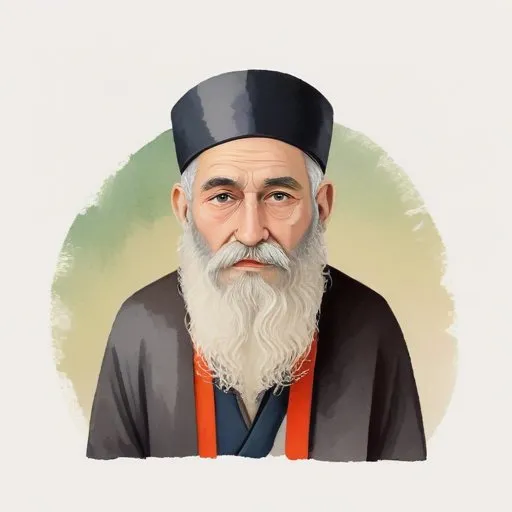
A 17th-century Jewish mystic and messianic leader who sparked a massive following with his claims of being the long-awaited Messiah, shaking the foundations of Jewish tradition and sparking controversy.
Sabbatai Zevi was a 17th-century Ottoman Jewish mystic and ordained rabbi who claimed to be the long-awaited Jewish Messiah, founding the Sabbatean movement that shook the foundations of the Jewish community. Born in Smyrna, Turkey in 1626, Zevi's life was marked by controversy, spiritual exploration, and a dramatic conversion to Islam that left a lasting impact on Jewish history.
Zevi was born into a Romaniote Jewish family in Smyrna, supposedly on Tisha B'Av, a Jewish holy day of mourning. His father, Mordecai, was a poultry dealer who achieved some wealth as the Smyrna agent of an English trading house. Zevi's family was of Ashkenazi origin, and his name, meaning Saturn in Hebrew, was often linked to the advent of the Messiah in Jewish tradition.
Zevi's charismatic personality and messianic claims drew thousands of followers across the Ottoman Empire. He preached a message of redemption and salvation, proclaiming that he was the long-awaited Messiah who would bring about a new era of peace and prosperity. His movement, known as the Sabbatean movement, attracted many prominent Jewish leaders and scholars who saw him as a beacon of hope.
In 1666, Zevi was imprisoned by the Ottoman authorities on accusations of fomenting sedition. Faced with the choice of death or conversion to Islam, Zevi chose the latter, donning a turban and adopting the name Aziz Mehmed Effendi. This decision shocked his followers, who were deeply divided over his actions. About 300 families who followed Zevi also converted to Islam, becoming known as Dönmeh.
Zevi was later banished to Constantinople and then to the small town of Ulcinj in present-day Montenegro, where he lived in relative isolation. Despite his fall from grace, Zevi continued to attract a devoted following, who saw him as a spiritual leader and mystic.
Zevi's teachings were a unique blend of Jewish mysticism, Kabbalah, and Islamic influences. He believed in the importance of spiritual ecstasy and the power of the individual to attain a state of divine union. His philosophy emphasized the need for Jews to return to their spiritual roots and to reject the strictures of traditional rabbinic authority.
Zevi's legacy is complex and multifaceted. While his conversion to Islam was seen as a betrayal by many, it also paved the way for a new era of Jewish-Muslim dialogue and cooperation. The Sabbatean movement continued to thrive long after Zevi's death, influencing many prominent Jewish leaders and thinkers, including the famous Jewish mystic and leader, Jacob Frank.
Zevi's life and teachings were marked by controversy and scandal. Many saw him as a charlatan or a false Messiah, while others viewed him as a spiritual leader and visionary. His conversion to Islam was seen as a betrayal by many, and it remains a topic of debate among historians and scholars to this day.
Zevi's life and teachings continue to fascinate and inspire people to this day, offering a glimpse into a complex and tumultuous period in Jewish history.
Born in 1632
A 17th-century philosopher and scholar who developed a comprehensive philosophical system that emphasizes God, nature, and human freedom, influencing modern thought on ethics, politics, and religion.
Born in 1878
A philosopher who explored the nature of human relationships, dialogue, and existence, and is best known for his concept of "I-Thou" relationships, which emphasizes mutual respect and understanding.
Born in 1907
A prominent Jewish scholar who merged traditional faith with modern philosophy, advocating for social justice and interfaith dialogue through his influential writings and activism.
98 Years Old
A Romanian-American writer, professor, and humanitarian who survived the Holocaust and dedicated his life to promoting peace, justice, and human rights, leaving a lasting impact on literature and activism.
Born in 1913
A Belarusian-born Israeli politician who served as Prime Minister of Israel and was awarded the Nobel Peace Prize for his efforts to establish a peace treaty with Egypt. He's known for his strong leadership and commitment to Israeli security.
Born in 1923
A Nobel Peace Prize winner who served as Israel's President and Prime Minister, known for his efforts to bring peace to the Middle East through diplomatic negotiations.
Born in 1922
A renowned Israeli leader and peacemaker who played a crucial role in shaping the country's history and was awarded the Nobel Prize for his efforts towards peace in the Middle East.
