


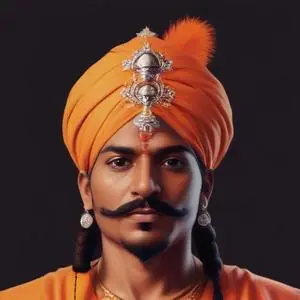
The second ruler of the Maratha Empire, known for his bravery and military campaigns against the Mughal Empire, and his efforts to protect Hindu culture and traditions.
Sambhaji, the second Chhatrapati of the Maratha Kingdom, is remembered for his unwavering bravery and strategic military prowess in the face of overwhelming odds. His reign, from 1681 to 1689, was marked by relentless wars against the Mughal Empire and other neighboring powers, solidifying his place in Indian history as a fearless warrior and astute leader.
Born on May 14, 1657, at Purandar fort, Sambhaji was the eldest son of Shivaji, the founder of the Maratha Kingdom, and his first wife, Saibai. After his mother's death, he was raised by his paternal grandmother, Jijabai. This early exposure to the complexities of royal politics and military strategy would shape his future as a shrewd and fearless leader.
Sambhaji's life was inextricably linked with the ongoing wars between the Marathas and the Mughal Empire. He was sent as a political hostage to Raja Jai Singh I of Amber at the age of nine, as part of the Treaty of Purandar, and later attended the Mughal emperor Aurangzeb's court at Agra with his father Shivaji. This experience fostered in him a deep understanding of the intricate web of alliances and rivalries that defined the region's politics.
Sambhaji's military campaigns were marked by ingenuity and valour. He successfully attacked the Mughal territories in the north, captured several forts, and even raided the Portuguese colonies in Goa. His most notable achievement was the capture of the strategic fort of Burhanpur, which gave the Marathas control over the rich trade routes of the Deccan plateau.
Sambhaji's reign came to an abrupt end when he was captured by Aurangzeb's forces and executed on March 11, 1689. Despite his untimely death, Sambhaji's legacy as a fearless warrior and national hero has endured. His brother, Rajaram I, succeeded him as the next Chhatrapati and continued the Mughal-Maratha Wars, cementing Sambhaji's place in history as a champion of Maratha resistance against Mughal occupation.
Sambhaji's life and reign were deeply influenced by his father's ideals of Swarajya, or self-rule, and the importance of protecting the Maratha kingdom from external threats. He embodied the spirit of resistance against oppressive forces, inspiring generations of Indians to fight for their freedom and autonomy.
Sambhaji's legacy extends beyond the boundaries of the Maratha Kingdom. He is remembered as a symbol of resistance against oppression, inspiring nationalist movements across India. His military campaigns and conquests have been studied by historians and strategists, offering valuable insights into the complexities of war and statecraft.
"I would rather die than submit to the Mughal Empire." - Sambhaji
This quote, attributed to Sambhaji, captures the essence of his unwavering commitment to the cause of Maratha independence and self-rule.
Sambhaji's life and reign are set against the backdrop of the Mughal-Maratha Wars, a period of intense conflict and upheaval in Indian history. His bravery, strategic genius, and unwavering commitment to the Maratha cause have cemented his place in the annals of Indian history, inspiring generations of Indians to fight for their freedom and autonomy.
Born in 1630
Founder of the Maratha Empire, a powerful Indian kingdom that resisted Mughal rule, known for military prowess, strategic genius, and unifying warring factions. He is revered as a national hero in India.
