


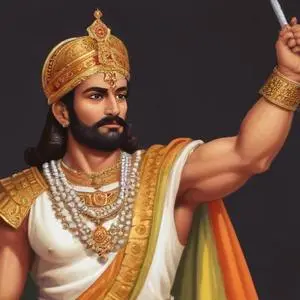
Founder of the Maratha Empire, a powerful Indian kingdom that resisted Mughal rule, known for military prowess, strategic genius, and unifying warring factions. He is revered as a national hero in India.
Shivaji, also known as Chhatrapati Shivaji Maharaj, is revered as the founder of the Maratha Empire, a powerful and influential Indian kingdom that played a significant role in shaping the country's history. Born in 1630, Shivaji is celebrated for his bravery, strategic military campaigns, and administrative acumen, which enabled him to carve out an independent kingdom from the declining Adilshahi Sultanate of Bijapur.
Shivaji was born in the hillfort of Shivneri, near the city of Junnar, in what is now Pune district. His father, Shahaji Bhonsale, was a Maratha nobleman who served as a general in the Bijapur Sultanate, while his mother, Jijabai, was a pious and influential woman who played a significant role in Shivaji's upbringing and early life.
Shivaji's early military campaigns were marked by a series of successful battles against the Bijapur Sultanate, which enabled him to capture several key forts and territories. In 1674, he was formally crowned the Chhatrapati of his realm at Raigad Fort, marking the beginning of the Maratha Empire.
Shivaji's military forces were known for their bravery, discipline, and innovative tactics. He introduced several reforms, including the concept of "guerrilla warfare," which involved hit-and-run attacks on enemy forces. He also established a strong navy, which played a crucial role in the Maratha Empire's expansion.
Shivaji is also credited with introducing several administrative reforms, including a well-structured civil administration, a robust system of taxation, and a network of roads and public buildings. He promoted the use of the Marathi and Sanskrit languages, replacing Persian as the official language of his court and administration.
Shivaji's legacy extends beyond his military campaigns and administrative reforms. He is revered as a unifying force for India, who played a significant role in shaping the country's history and culture. His values of courage, perseverance, and self-sacrifice continue to inspire generations of Indians.
Shivaji's legacy gained significance during the Indian independence movement, when he was hailed as a "protonationalist" and a hero of the Hindus. Indian nationalists, such as Mahatma Gandhi, drew inspiration from Shivaji's bravery and his struggle against foreign rule.
Shivaji's personal life was marked by a strong sense of family values and relationships. He was married to Saibai, who played a significant role in his life and administration. He also had several close relationships with his military generals and advisors, who were loyal and dedicated to his cause.
Shivaji's philosophical contributions and beliefs were shaped by his strong sense of Hinduism and his commitment to social justice. He believed in the importance of protecting his people and his kingdom, and was willing to make sacrifices for the greater good.
Shivaji's quotes and memorable sayings continue to inspire generations of Indians. One of his most famous quotes is: "I am not a king, I am a servant of the people."
Shivaji's life and legacy have been the subject of several controversies and debates. Some historians have criticized his treatment of Muslims and other minority communities, while others have hailed him as a hero and a symbol of Indian resistance against foreign rule.
Shivaji's historical context and legacy must be understood in the context of 17th-century India, a period marked by Mughal rule and European colonialism. His bravery and strategic diplomacy enabled him to carve out an independent kingdom, which played a significant role in shaping India's history and culture.
Shivaji's life and legacy can be compared to that of his contemporaries, such as the Mughal Emperor Aurangzeb and the Sultan of Bijapur, Adil Shah. While Aurangzeb was known for his military campaigns and administrative reforms, Shivaji's bravery and strategic diplomacy were unmatched in his time.
Historians have speculated about Shivaji's plans and strategies, had he lived longer. Some believe that he would have expanded his empire further, while others argue that he would have continued to strengthen his administration and military forces.
DID YOU KNOW? Shivaji was known for his love of horses and had a vast stable of horses in his kingdom. He was also a skilled horseman and would often ride into battle on horseback.
Shivaji's life and legacy continue to inspire generations of Indians, and his bravery, strategic diplomacy, and administrative reforms remain an integral part of Indian history and culture.
Born in 1657
The second ruler of the Maratha Empire, known for his bravery and military campaigns against the Mughal Empire, and his efforts to protect Hindu culture and traditions.
Born in 1666
A spiritual leader who founded the Sikh warrior community and wrote poetic compositions that are still revered today, known for his bravery and spiritual guidance.
Born in 1618
The Mughal emperor who ruled India from 1658 to 1707, expanding the empire to its greatest extent and implementing Islamic law, while also being known for his architectural achievements, including the Badshahi Mosque.
Born in 1540
A 16th-century Rajput king who fought against the Mughal Empire, known for his bravery and resistance against foreign rule. He is celebrated as a hero in Indian history.
