


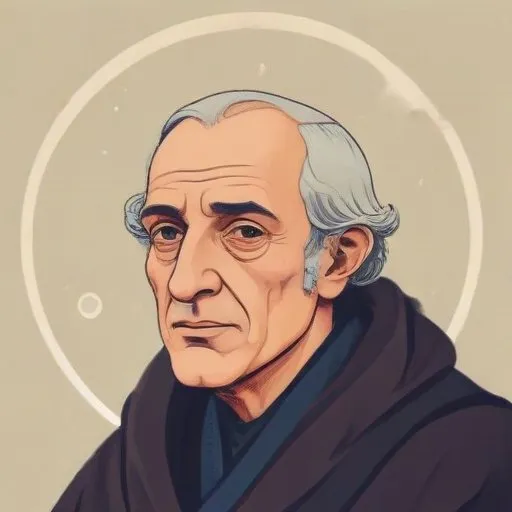
An 18th-century Italian philosopher and astronomer who wrote about the relationship between faith and reason, and made significant contributions to the fields of astronomy and mathematics. He later became Pope Pius VII, playing a key role in shaping the Catholic Church's response to the Enlightenment and French Revolution.
Scipione Chiaramonti is best known for his opposition to the renowned astronomer Galileo, but his contributions to philosophy, mathematics, and natural sciences are just as noteworthy. As a prominent figure of the 16th and 17th centuries, Chiaramonti left an indelible mark on the intellectual landscape of his time.
Born on June 21, 1565, into a noble and wealthy family, Chiaramonti was destined for greatness. His family claimed to have originated in Clermont and moved to Italy in the 14th century, producing a future Pope, Pius VII, among its ranks. Chiaramonti's father was a doctor, and he studied at the University of Ferrara, where he lodged with Cardinal Alessandro d'Este and later associated with the circle of Cardinal Curzio Sangiorgi.
Chiaramonti's intellectual curiosity knew no bounds. He was well-versed in medieval and humanistic natural philosophy, and his expertise in mathematics, optics, and perspective led him to establish a Lyceum at his home, where he taught these subjects to enthusiastic pupils. Among his disciples was the renowned art theorist Matteo Zaccolini.
In 1592, Chiaramonti met Galileo, who was passing through Cesena on his way to Pesaro. Galileo described Chiaramonti as "very gifted in mathematics." However, their initial encounter was only the beginning of a scientific rivalry that would last a lifetime. Chiaramonti's treatise on mathematical problems in artillery, written in 1598, demonstrated his mastery of the field, but his opposition to Galileo's views on comets would become a defining feature of his career.
In 1601, Chiaramonti was appointed as an interpreter of natural philosophy to the academy of Perugia, earning an annual salary of 340 scudi. He also received a generous allowance of 400 ducats from Cardinal Alessandro d'Este. His services were in high demand, and he went on to serve as mathematician and advisor to Cesare d'Este, Duke of Modena, and later to Cardinal Cinzio Passeri Aldobrandini.
Scipione Chiaramonti's contributions to philosophy, mathematics, and natural sciences are a testament to his boundless intellectual energy. His opposition to Galileo, though controversial, underscores his commitment to the pursuit of knowledge and his willingness to challenge established authorities. As we reflect on his life and work, we are reminded that the love of learning and the courage to dissent are essential qualities of a true scholar.
Chiaramonti's legacy extends beyond his intellectual achievements, as his family continued to produce notable figures, including Pope Pius VII. His impact on modern society is a powerful reminder that the pursuit of knowledge and wisdom is a never-ending journey, requiring courage, curiosity, and dedication.
Born in 1724
Developed influential philosophical frameworks, such as the Critique of Pure Reason, that shaped modern Western thought on ethics, morality, and human understanding.
Born in 1712
A pioneering thinker who shaped modern democracy and education with his ideas on social contracts, general will, and the importance of early childhood education. His writings influenced the French Revolution and modern political thought.
Born in 1694
A witty and insightful 18th-century writer and philosopher who used satire to critique societal norms and advocate for reason, tolerance, and human rights.
Born in 1717
A French Enlightenment thinker who made significant contributions to mathematics, physics, and philosophy, particularly in the fields of fluid dynamics and the study of vibrating strings. He's also known for his work on the Encyclopedia, a comprehensive reference work that aimed to compile all knowledge of the time.
Born in 1749
Developed nebular hypothesis of the origin of the solar system and formulated Laplace's equation, a fundamental concept in mathematics and physics. He's considered the founder of celestial mechanics.
Born in 1736
Developed calculus, number theory, and celestial mechanics, making significant contributions to the fields of mathematics and astronomy.
Born in 1752
Developed the theory of elliptic integrals, and his work on number theory laid the foundation for modern cryptography.
