


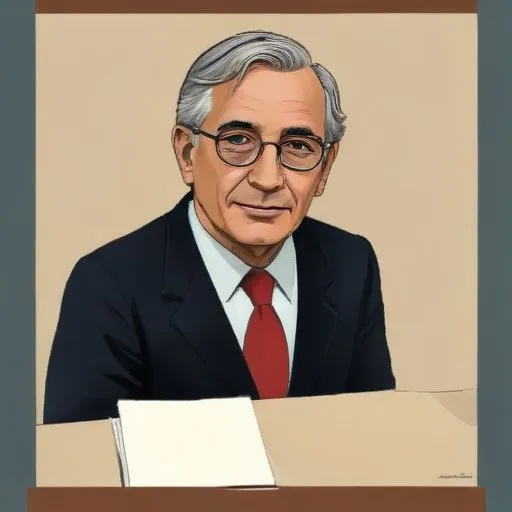
A pioneering economist and educator who advocated for simple living, self-sufficiency, and social justice, inspiring a back-to-the-land movement in the 1930s-1970s.
Scott Nearing, a prominent American radical economist, educator, and writer, is best known for his advocacy of simple living, pacifism, and vegetarianism. Through his writings and activism, Nearing inspired generations of social reformers, environmentalists, and counterculturalists to rethink their values and lifestyles.
Born on August 6, 1883, in Morris Run, Pennsylvania, Nearing grew up in a life of privilege, courtesy of his grandfather's successful mining operations. However, his parents instilled in him a strong social conscience and a love for nature, books, and the arts. His mother, in particular, played a significant role in shaping his values and ideals.
Nearing's career spanned multiple fields, including economics, education, and writing. He was a prolific author, penning over 50 books and numerous articles on topics ranging from economics and politics to philosophy and social reform. Some of his notable works include:
Nearing's philosophical framework was rooted in a critique of modern industrial society. He believed that people had become disconnected from nature and were consumed by materialism, leading to social and environmental problems. He advocated for a simpler way of living, based on self-sufficiency, cooperation, and a reconnection with nature.
Nearing's ideas and lifestyle have inspired a wide range of individuals and movements, from the counterculturalists of the 1960s to modern-day environmentalists and minimalists. His emphasis on simple living, local food systems, and eco-friendly practices has influenced the development of sustainable living movements and communities.
Nearing's radical views and critiques of mainstream society often put him at odds with the establishment. He was dismissed from his teaching position at the University of Pennsylvania in 1915 due to his anti-war stance and criticism of capitalism. Despite these controversies, Nearing remained committed to his ideals and continued to inspire and challenge the status quo.
In 1932, Nearing and his wife, Helen, relocated to Vermont, where they established a self-sufficient homestead, living off the land and rejecting the trappings of modern consumer culture. This experiment in simple living became a model for many and inspired a generation of homesteaders and ecologists.
Scott Nearing's life and work serve as a testament to the power of radical ideas and alternative lifestyles. His commitment to social justice, environmentalism, and simple living continues to inspire individuals and communities around the world, making him one of the most influential and enduring figures of the 20th century.
As Nearing himself once said, "The price of freedom is not a trivial thing. It is a solemn and magnificent responsibility."
Born in 1839
Pioneering economist and social reformer who advocated for a single-tax system, where all government revenue would come from a land value tax, to reduce poverty and inequality.
Born in 1859
Developed pragmatic philosophy and progressive education theories, focusing on hands-on learning and social reform. Known for his influential ideas on democracy, education, and individual freedom.
Born in 1857
A pioneering economist and sociologist who coined the term "conspicuous consumption" to describe how people use luxury goods to showcase their social status, and is known for his critical views on capitalism.
Born in 1855
A pioneering labor leader who fought for workers' rights and social justice, founding the Industrial Workers of the World and running for president five times on the Socialist Party ticket.
Born in 1878
A pioneering muckraker, exposing social and economic injustices through influential novels, most notably "The Jungle", which led to significant reforms in the meatpacking industry.
Born in 1884
A prominent socialist leader who ran for president six times, advocating for workers' rights and social justice. He was a vocal critic of capitalism and a strong advocate for civil liberties.
Born in 1885
A Dutch-American pastor and activist who advocated for pacifism, labor rights, and civil rights, influencing the development of nonviolent resistance movements.
92 Years Old
A pioneering consumer advocate and presidential candidate, known for his tireless crusade against corporate greed and government negligence, particularly in the areas of environmental protection and product safety.
