


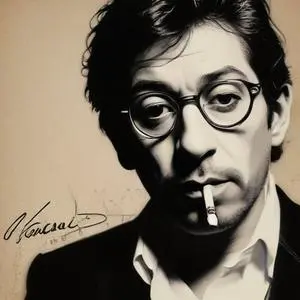
A French icon who blended jazz, pop, and literature to create provocative, sensual, and poetic music and films, leaving a lasting mark on French culture.
Serge Gainsbourg was a French singer-songwriter, actor, composer, and director known for his provocative and often controversial releases that sparked public debate in France. With a career spanning over four decades, he left an indelible mark on French pop, experimenting with a wide range of genres, from jazz and chanson to rock, zouk, funk, reggae, and electronica.
Born Lucien Ginsburg on 2 April 1928 in Paris, France, Gainsbourg was the son of Russian-Jewish migrants, Joseph and Olga Ginsburg, who fled to Paris via Istanbul after the 1917 Russian Revolution. His father, a classically trained musician, taught him and his twin sister Liliane to play the piano, instilling in them a love for music from an early age.
Gainsbourg's childhood was profoundly affected by the occupation of France by Germany during World War II. The experience would later influence his artistic output, often reflecting his observations of the human condition during times of turmoil.
Gainsbourg's artistic output was as eclectic as it was prolific. He wrote over 550 songs, which have been covered more than 1,000 times by diverse artists. His lyrical works incorporated wordplay, with humorous, bizarre, provocative, sexual, satirical, or subversive overtones, making him a master of storytelling through music.
From the early days of jazz and chanson to his later experiments in rock, zouk, funk, reggae, and electronica, Gainsbourg's varied musical style and individuality made him difficult to categorize. His iconic songs, such as "Je t'aime... moi non plus" and "Bonnie and Clyde," continue to captivate audiences worldwide.
Gainsbourg's provocative nature often sparked controversy, dividing public opinion in France. His songs and public persona were frequently criticized for being too raunchy, too political, or too subversive. However, this notoriety only added to his allure, solidifying his status as a rebellious iconoclast.
Serge Gainsbourg's music has reached legendary stature in France, and his legacy continues to inspire new generations of artists and fans worldwide. Since his death from a second heart attack in 1991, he has become one of France's best-loved public figures, with a cult following that transcends borders and genres.
Gainsbourg's influence can be seen in numerous aspects of modern society, from music and fashion to film and literature. His unapologetic approach to art and his willingness to push boundaries have inspired a wide range of artists, from Madonna and Lenny Kravitz to Air and Jarvis Cocker.
"I'd rather be a failure at something I love than a success at something I hate."
"The only thing I know is that I paint, I write, and I make music. And that's what I'll keep doing until I die."
Gainsbourg's provocative spirit, innovative genius, and unwavering commitment to his art continue to fascinate audiences today, cementing his status as one of the most important figures in French pop.
79 Years Old
A iconic actress and singer who charmed audiences with her unique voice and style, starring in French New Wave films and singing sensual duets with Serge Gainsbourg.
92 Years Old
French actress and model who symbolized the liberated woman of the 1960s, starring in films like "And God Created Woman" and "Contempt". Known for her iconic beauty, charming on-screen presence, and advocacy for animal rights.
94 Years Old
A pioneering filmmaker of the French New Wave, known for directing iconic films like "Jules and Jim" and "The 400 Blows", which redefined cinematic storytelling.
95 Years Old
A pioneer of French New Wave cinema, known for experimental and provocative films that challenged traditional narrative structures and explored themes of politics, philosophy, and social commentary.
82 Years Old
A renowned French actress and singer, iconic for her striking beauty and versatile performances in films like "Belle de Jour" and "Indochine". She's a symbol of French cinema and elegance.
