


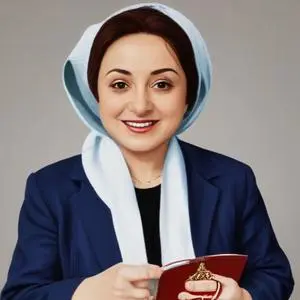
A pioneering Iranian lawyer, judge, and activist who fought for human rights and democracy, especially for women and children, and was awarded the Nobel Peace Prize in 2003.
Shirin Ebadi, a trailblazing Iranian lawyer, judge, and writer, is hailed as a pioneering force in the fight for democracy, women's rights, and human rights. In 2003, she made history by becoming the first Muslim woman and the first Iranian to receive the Nobel Peace Prize, recognized for her tireless efforts to promote peace, justice, and equality.
Born on June 21, 1947, in Hamadan, Iran, Shirin Ebadi grew up in an educated Persian family. Her father, Mohammad Ali Ebadi, was a professor of commercial law and the chief notary public of the city, while her mother, Minu Yamini, was a homemaker. After moving to Tehran at a young age, Ebadi attended Anoshiravn Dadgar and Reza Shah Kabir schools.
She pursued her passion for law, earning a degree from the University of Tehran in 1969. After completing a six-month internship, she became a judge in March 1969, a remarkable feat for a woman in Iran at the time.
In 1971, Ebadi earned her doctorate in law from the University of Tehran, with one of her professors being the esteemed Mahmoud Shehabi Khorassani. Her academic excellence and dedication to her craft led to her appointment as the first female president of the Tehran city court in 1975.
However, her promising career was abruptly halted by the 1979 Iranian Revolution, which stripped her of her judgeship and relegated her to a clerical position. Despite the setback, Ebadi persevered, using her downtime to write books and articles, which would later become a cornerstone of her activism.
In 1993, Ebadi was finally allowed to practice law, and she seized the opportunity to advocate for human rights, women's rights, and children's rights. She founded the Defenders of Human Rights Center in Iran, an organization dedicated to providing legal aid to marginalized communities and promoting democracy.
Through her work, Ebadi has been a vocal critic of Iran's human rights abuses, particularly against women and minorities. Her tireless efforts have made her a target for persecution, but she remains undeterred in her pursuit of justice.
In 2003, Ebadi's contributions to human rights and democracy were recognized with the Nobel Peace Prize. This honor not only cemented her status as a global icon but also made her a target for the Iranian government.
In 2009, faced with increasing threats and persecution, Ebadi was forced into exile in London. Despite the distance, she continues to advocate for human rights and democracy in Iran, inspiring countless individuals around the world.
Shirin Ebadi's unwavering commitment to human rights and democracy has inspired a generation of activists, lawyers, and judges. Her work has paved the way for women's empowerment and has brought attention to the plight of marginalized communities in Iran.
Through her writing, teaching, and advocacy, Ebadi has left an indelible mark on human rights discourse, reminding us that the struggle for justice and equality is a universal one.
Shirin Ebadi's remarkable journey serves as a beacon of hope, illuminating the path for future generations of human rights advocates and inspiring us all to strive for a more just and equitable world.
29 Years Old
A courageous advocate for girls' education, particularly in her native Swat Valley, who survived a Taliban assassination attempt and continues to inspire global change through her activism and writing.
Born in 1918
A South African lawyer and politician who fought against apartheid, becoming the country's first black president and a symbol of racial reconciliation, earning a Nobel Peace Prize. He's a beacon of hope and freedom.
94 Years Old
A prominent religious leader and human rights advocate who fought against apartheid and racism, known for his tireless efforts to promote equality and forgiveness.
Born in 1924
A naval officer turned politician who served as the 39th President of the United States, known for his commitment to human rights and social justice, and awarded the Nobel Peace Prize in 2002.
88 Years Old
A renowned international diplomat who led the United Nations from 1997 to 2006, promoting global cooperation and development, and receiving the Nobel Peace Prize in 2001.
86 Years Old
A Bangladeshi economist and founder of Grameen Bank, he pioneered microcredit and microfinance, providing small loans to millions of impoverished people, especially women, to start their own businesses.
78 Years Old
The 45th Vice President of the United States and Nobel Prize laureate is a prominent advocate for environmental protection, particularly climate change awareness, and has produced influential documentaries on the subject.
65 Years Old
The first African American to hold the office, he served two terms as President of the United States, earning a Nobel Peace Prize for his efforts to strengthen international diplomacy and cooperation. He's known for his charismatic leadership and commitment to progressive values.
