


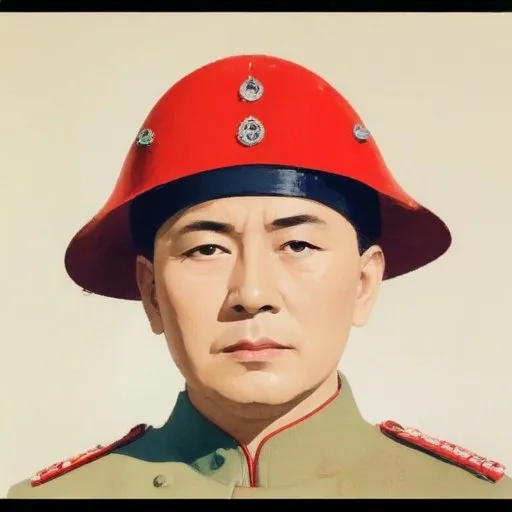
A Japanese general who played a crucial role in the country's military expansion during World War II, particularly in the invasion of China and Southeast Asia. He was also a key figure in the Imperial Japanese Army's high command.
Shizuichi Tanaka, born on October 1, 1887, is famously known for being a general in the Imperial Japanese Army and serving as the Japanese Military Governor of the Philippines during World War II. His unconventional background and reputation for being pro-Western set him apart from his counterparts in the Japanese military hierarchy.
Tanaka was born in Issai village, Hyogo prefecture, now part of the city of Tatsuno, to a family of large landowners claiming descent from Akamatsu Mitsusuke, a prominent samurai of the Edo period. His family's history in serving as village heads during the Edo period forged a strong sense of duty and responsibility in young Tanaka.
He graduated from the 19th class of the Imperial Japanese Army Academy in 1907, alongside his classmate Masaharu Homma. Tanaka's academic prowess earned him a spot at the Army Staff College, where he graduated with honors in 1916, specializing in infantry. A prestigious Army scholarship took him to England, where he earned a degree in English literature at Oxford University, with a focus on the works of William Shakespeare.
Tanaka's military career was marked by rapid promotions, starting with his assignment as a flag bearer for the Japanese troops in London's victory parade at the end of World War I in July 1918. He was promoted to major in 1922, and soon after, he took on the role of military liaison to the Japanese consulate in Mexico in 1926.
His stint in Mexico was followed by promotions to lieutenant colonel in 1927 and colonel in 1930. During this period, he headed the North American Bureau within the Imperial Japanese Army General Staff and commanded the IJA 2nd Infantry Regiment until 1932. Tanaka's experience in the United States, where he met Douglas MacArthur, further solidified his pro-Western sentiments.
Tanaka's exposure to Western culture and his education at Oxford University instilled in him a deep appreciation for Western values and ideals. His philosophical beliefs were often at odds with the militaristic and nationalist sentiments prevalent in Japan during the 1930s and 1940s.
His pro-Western stance, however, did not hinder his commitment to serving his country. Tanaka remained loyal to the Japanese Army, even when passed over for promotions due to his unconventional views. This dichotomy highlights the complexity of Tanaka's character, making him a fascinating and multifaceted historical figure.
Tanaka's life and career serve as a testament to the complexities of Japan's military history during World War II. His story raises important questions about the role of individual agency in the face of nationalist fervor and militarization.
As a historical figure, Tanaka's legacy is multifaceted, encompassing both his military achievements and his philosophical beliefs. His life serves as a reminder that even in the most tumultuous of times, individuals can hold divergent views and still remain committed to their nation's cause.
Tanaka's legacy continues to inspire historians and scholars, offering a nuanced understanding of Japan's role in World War II and the men who shaped its military history.
Born in 1901
The Japanese emperor who ruled from 1926 to 1989, leading the country through World War II and its post-war reconstruction, and is known for his symbolic role in Japanese politics and culture. He is also remembered for his rare public apology for Japan's wartime atrocities.
Born in 1884
Led the Imperial Japanese Navy during World War II, masterminding the surprise attack on Pearl Harbor, and later became a symbol of Japanese military power and strategy.
