


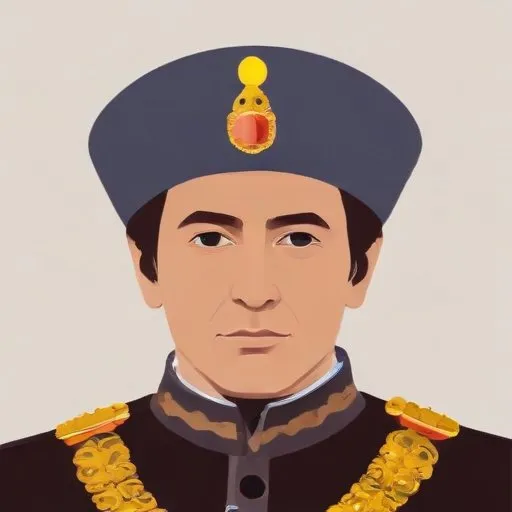
A ruthless 15th-century Italian condottiero and lord of Rimini, known for his military prowess, cunning, and scandalous personal life. He commissioned the famous Tempio Malatestiano, a Renaissance architectural masterpiece.
Sigismondo Pandolfo Malatesta was a renowned Italian condottiero, nobleman, and lord of Rimini and Fano from 1432, celebrated for his daring military leadership and patronage of the arts. Widely respected by his contemporaries, he commanded the Venetian forces in the 1465 campaign against the Ottoman Empire, cementing his reputation as one of Italy's most esteemed military leaders.
Sigismondo was born on June 19, 1417, in Brescia, northern Italy, as the elder of two illegitimate sons of Pandolfo III Malatesta and Antonia da Barignani. His younger brother, Domenico, known as Malatesta Novello, was born in 1418. The family's tradition of military service led Sigismondo to debut as a man-at-arms at the age of 13, fighting against his relative Carlo II Malatesta, lord of Pesaro, who sought to annex Rimini, Cesena, and Fano to his territories.
Following his victory, Sigismondo, along with his brothers Galeotto Roberto and Domenico, obtained the title of Papal vicar for Rimini, Cesena, and Fano. In 1431, he repelled another invasion by the Malatestas of Pesaro, despite having inferior forces. When his elder brother abdicated, Sigismondo became lord of Rimini at the age of 15. He went on to serve as commander of a papal corps, defeating the Spanish condottiero Sante Cirillo and thwarting Antonio I Ordelaffi's attempt to capture Forlì in 1435-1436.
Beyond his military prowess, Sigismondo was a poet and patron of the arts, fostering a cultural renaissance in Rimini. He attracted prominent artists, writers, and intellectuals to his court, including the humanist scholar Roberto Valturio, who dedicated his treatise on war machines, De Re Militari, to Sigismondo. The condottiero's love for poetry and literature earned him recognition as a prominent figure in the Italian Renaissance.
In 1434, Sigismondo married his niece, Ginevra d'Este, daughter of Niccolò III and Parisina Malatesta, his first cousin. This union sparked controversy due to their close familial ties. Sigismondo's tumultuous relationships with the papacy led to his excommunication in 1433, which was later revoked.
Sigismondo Pandolfo Malatesta's military campaigns and cultural patronage left an indelible mark on Italian history. His legacy extends beyond his lifetime, influencing the development of modern warfare and the Renaissance humanist movement. As a testament to his enduring impact, Sigismondo remains a celebrated figure in Italian history, remembered for his bravery, strategic genius, and cultural achievements.
Born in 1422
A renowned Italian mercenary captain and skilled military leader, known for his bravery, strategic genius, and cultural patronage, who commissioned iconic artworks and architecture.
Born in 1480
The illegitimate child of a powerful pope, known for her ruthless politics, alleged poisonings, and scandalous marriages that shaped the Italian Renaissance.
Born in 1475
A ruthless and cunning politician who rose to power in the Renaissance era through intrigue and military conquest, leaving a lasting legacy in politics and governance.
Born in 1414
Established the Vatican Archives and commissioned the Sistine Chapel's ceiling, which was famously painted by Michelangelo. He also played a significant role in the Renaissance.
Born in 1487
A 16th-century Pope who commissioned Michelangelo to paint the Sistine Chapel's frescoes and was a patron of the arts, leaving a lasting impact on Renaissance art and architecture.
Born in 1469
Italian historian and philosopher who wrote "The Prince", a seminal work on politics and power that still influences modern leadership and governance today.
Born in 1401
The Duke of Milan, a powerful Renaissance leader, expanded his dominion through strategic marriages and military campaigns, fostering a cultural and artistic boom in 15th-century Italy.
Born in 1452
Ruler of Milan who commissioned Leonardo da Vinci's famous painting, The Last Supper, and was a patron of the arts and architecture.
