


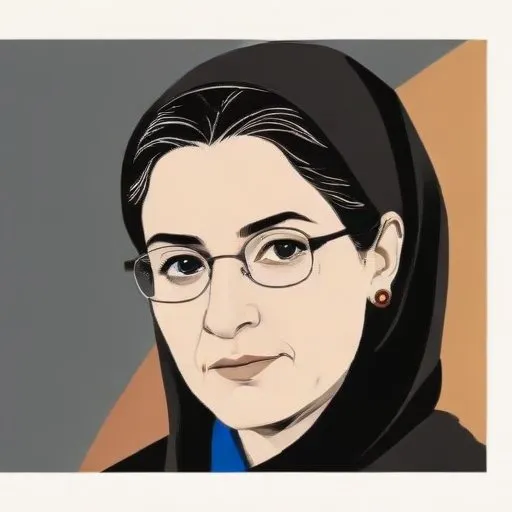
A pioneering female writer and educator who broke literary ground with her Persian novels and short stories, exploring themes of social justice and women's rights.
Simin Daneshvar, a trailblazing Iranian novelist, fiction writer, and translator, is renowned for being the first major Iranian woman novelist, leaving an indelible mark on the country's literary landscape. Her groundbreaking works, which delved into the lives of ordinary Iranians, particularly women, set against the backdrop of Iran's tumultuous political and social climate, solidified her position as a literary icon.
Born on April 28, 1921, in Shiraz, Iran, Simin Daneshvar was the daughter of Mohammad Ali Daneshvar, a physician, and a painter mother. She demonstrated an affinity for writing from a young age, publishing her first article, "Winter Is Not Unlike Our Life," in a local newspaper while still in eighth grade.
Daneshvar's academic pursuits took her to the University of Tehran, where she enrolled in the Persian literature department in 1938. Tragedy struck in 1941, when her father's untimely death forced her to support herself by writing for Radio Tehran under the pseudonym "The Nameless Shirazi." During this time, she penned pieces on cooking, food, and various other topics.
Daneshvar's literary journey was marked by several milestones. Her collection of Persian short stories, published in 1948, was the first by an Iranian woman. This feat was followed by the publication of her novel, Savushun (Mourners of Siyvash, also known as A Persian Requiem), in 1966, which became a bestseller and solidified her position as a pioneering Iranian novelist.
Her translated works, including Playhouse, a collection of five stories and two autobiographical pieces, holds the distinction of being the first volume of translated stories by an Iranian woman author. Daneshvar's translation of famous works, such as The Cherry Orchard by Anton Chekhov and The Scarlet Letter by Nathaniel Hawthorne, further demonstrated her linguistic proficiency and cultural appreciation.
Daneshvar's influence extended beyond her writings. As the wife of the celebrated Iranian writer Jalal al-Ahmad, she played a profound role in shaping his literary works. After his passing, Daneshvar wrote The Dawn of Jalal in his memory, showcasing her devotion to her late husband and their shared passion for literature.
Through her works, Daneshvar provided a voice to the voiceless, particularly Iranian women, who had long been marginalized in society. Her contributions paved the way for future generations of Iranian women writers, ensuring her legacy as a trailblazer in the world of Persian literature.
Simin Daneshvar's personal life was marked by the absence of children, a sacrifice she and her husband made to focus on their literary pursuits. Her later years were shrouded in tragedy, as her final book, intended to be the last installment of her trilogy, remains lost to this day.
Daneshvar's passing on March 8, 2012, marked the end of an era in Iranian literature. However, her remarkable achievements, literary prowess, and unyielding dedication to her craft continue to inspire generations of writers, scholars, and readers alike.
Born in 1903
A pioneering Iranian writer and translator who blended Persian folklore with European modernism, creating a unique literary style that explored themes of identity, alienation, and social critique.
87 Years Old
A pioneering filmmaker who revolutionized Iranian cinema with his poetic and visually stunning works, exploring themes of identity, culture, and social change.
80 Years Old
Iranian-American author and academic who wrote influential novels and short stories that explored themes of feminism, identity, and social change in Iran, earning her international recognition.
