


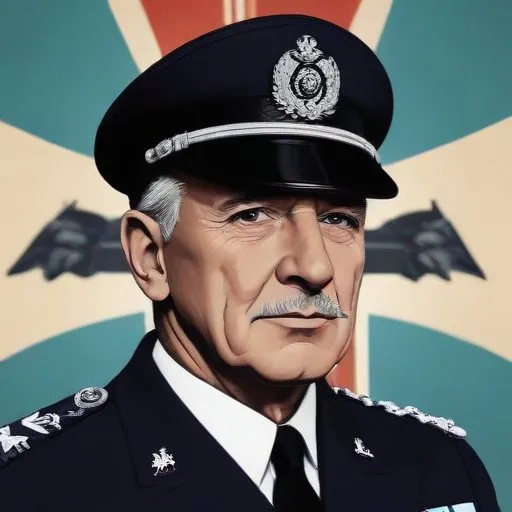
Led the Royal Air Force Bomber Command during World War II, overseeing strategic bombing campaigns against Germany and occupied Europe. He's infamous for advocating "area bombing" that led to widespread civilian casualties.
Sir Arthur Harris, 1st Baronet, is best known for his role as the Air Officer Commanding-in-Chief of RAF Bomber Command during World War II, earning him the nickname "Bomber Harris." Harris was the mastermind behind the Allies' strategic bombing campaign against Nazi Germany, which remains one of the most controversial and debated military strategies in history.
Born on April 13, 1892, in Gloucestershire, England, Harris emigrated to Rhodesia (now Zimbabwe) at the age of 17. He joined the 1st Rhodesia Regiment at the outbreak of World War I and saw action in South Africa and South West Africa. After the war, Harris returned to England and joined the Royal Flying Corps, which later became the Royal Air Force (RAF) in 1918.
Harris remained in the RAF throughout the 1920s and 1930s, serving in various postings including India, Mesopotamia, Persia, Egypt, and Palestine. His experience and skills earned him rapid promotions, and by the outbreak of World War II, Harris was well-positioned to take on a leading role in the RAF.
In February 1942, Harris was appointed head of Bomber Command, a position he held until the end of the war. Harris was tasked with implementing Prime Minister Winston Churchill's policy of area bombing German cities, a strategy aimed at weakening the Nazi war machine and breaking the German people's will to resist.
Harris was instrumental in developing tactics and technology to carry out area bombing, including the use of the Avro Lancaster bomber and the development of the "bomber stream" tactic. This approach involved sending large formations of bombers to target German cities, often resulting in devastating losses of civilian life and property.
Harris's area bombing strategy has been widely criticized for its indiscriminate targeting of civilians and its role in causing massive destruction and loss of life. The bombing of Dresden in February 1945, which resulted in an estimated 25,000 civilian deaths, remains one of the most controversial episodes of the war.
Harris and his supporters argued that area bombing was a necessary evil, as it weakened the German war effort and ultimately contributed to the Allied victory. Critics, however, have accused Harris of being responsible for a disproportionate number of civilian casualties and of conducting a campaign of terror bombing.
After the war, Harris moved to South Africa, where he managed the South African Marine Corporation. In 1953, he was created a baronet, a hereditary title. Harris died on April 5, 1984, at the age of 91.
Harris's legacy remains deeply contested. While some view him as a visionary military strategist who played a crucial role in the Allied victory, others see him as a ruthless and callous commander who prioritized military expediency over human life.
This quote, often attributed to Harris, reflects his unwavering commitment to the area bombing campaign and his belief in its military effectiveness.
Despite the controversy surrounding his legacy, Sir Arthur Harris, 1st Baronet, remains an important figure in the history of World War II and the development of strategic bombing as a military strategy.
Born in 1871
Prolific writer of historical novels and adventure stories, also a talented landscape painter.
Born in 1869
The Prime Minister who infamously appeased Nazi Germany with the Munich Agreement, hoping to avoid war, but ultimately contributing to its outbreak. He's a symbol of failed diplomacy and naivety in the face of aggression.
Born in 1893
A high-ranking Nazi official, he was a decorated World War I fighter pilot and later became a prominent politician, serving as Minister President of Prussia. He's infamous for his role in the Nazi regime and war crimes trials.
Born in 1878
The Soviet Union's ruthless leader who ruled with an iron fist, implementing policies that led to widespread famine and purges, while also playing a crucial role in defeating Nazi Germany in World War II.
Born in 1865
The second monarch of the House of Windsor, reigning from 1910 to 1936, known for leading the British Empire through World War I and modernizing the monarchy.
Born in 1890
Led the Allied forces to victory in World War II and later served as President, maintaining peace and prosperity during the Cold War era. He's known for his strategic leadership and diplomatic skills.
