


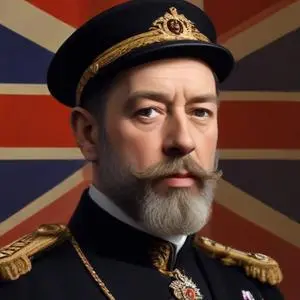
The second monarch of the House of Windsor, reigning from 1910 to 1936, known for leading the British Empire through World War I and modernizing the monarchy.
George V, born George Frederick Ernest Albert on June 3, 1865, was the King of the United Kingdom and the British Dominions, and Emperor of India, from 1910 until his death in 1936. He is best known for leading the British Empire through the tumultuous period of World War I and its aftermath, and for his role in transforming the British monarchy into the modern institution it is today.
Born as the second son of the Prince and Princess of Wales, George was third in the line of succession to the British throne. However, the unexpected death of his elder brother, Prince Albert Victor, in 1892 put him directly in line for the throne. From 1877 to 1892, George served in the Royal Navy, where he developed a strong sense of discipline and duty.
In 1893, George married Princess Victoria Mary of Teck, his brother's former fiancée, and they had six children together. When Queen Victoria died in 1901, George's father ascended the throne as Edward VII, and George was created Prince of Wales. He became king-emperor on his father's death in 1910.
George's reign saw the rise of socialism, communism, fascism, Irish republicanism, and the Indian independence movement, all of which radically changed the political landscape of the British Empire. He played a crucial role in shaping the empire's response to these movements, and his reign is often referred to as the "Golden Age" of the British Empire.
George suffered from smoking-related health problems during his later reign. Despite his health issues, he remained dedicated to his duties as king-emperor until his death on January 20, 1936.
George's reign had a profound impact on the British monarchy and the empire it ruled. He transformed the monarchy into a modern institution, and his leadership during World War I and its aftermath helped to shape the course of British history. Today, he is remembered as a dedicated and hardworking monarch who played a crucial role in shaping the British Empire into the modern Commonwealth it is today.
"I pray that God will help me to discharge my duties as King, and that I may be worthy of the trust which has been placed in me."
George's legacy continues to be felt today, and his commitment to duty and service remains an inspiration to people around the world.
Born in 1896
The American socialite who captivated the heart of a British king, causing him to abdicate the throne for love, sparking a constitutional crisis. She remains a symbol of romantic sacrifice and royal scandal.
Born in 1871
Prolific writer of historical novels and adventure stories, also a talented landscape painter.
Born in 1869
The Prime Minister who infamously appeased Nazi Germany with the Munich Agreement, hoping to avoid war, but ultimately contributing to its outbreak. He's a symbol of failed diplomacy and naivety in the face of aggression.
Born in 1867
A conservative leader who served as Prime Minister three times, known for his role in navigating Britain through economic crises and advocating for imperial protectionism.
Born in 1866
A Scottish journalist and politician who served as the first Labour Party Prime Minister of the United Kingdom, leading the country through significant economic and social reforms. He is also known for his efforts to maintain peace in Europe during the interwar period.
Born in 1863
A Welsh lawyer and politician who served as Prime Minister of the United Kingdom, leading the country through World War I and introducing key social reforms. He's known for his charismatic leadership and progressive policies.
Born in 1865
The second monarch of the House of Windsor, reigning from 1910 to 1936, known for leading the British Empire through World War I and modernizing the monarchy.
