


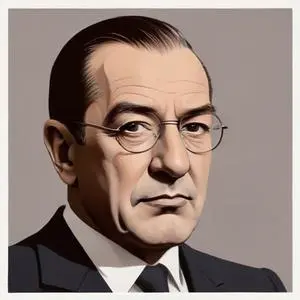
A conservative leader who served as Prime Minister three times, known for his role in navigating Britain through economic crises and advocating for imperial protectionism.
Stanley Baldwin, 1st Earl Baldwin of Bewdley, was a British statesman and Conservative politician who dominated the government of the United Kingdom between the world wars. He is best known for serving as Prime Minister on three separate occasions, leading the country through a period of significant economic and social change.
Born on August 3, 1867, in Bewdley, Worcestershire, Baldwin came from a prosperous family and was educated at Hawtreys, Harrow School, and Trinity College, Cambridge. He joined the family iron and steelmaking business before entering the House of Commons in 1908 as the member for Bewdley, succeeding his father Alfred.
Baldwin served as Financial Secretary to the Treasury from 1917 to 1921 and President of the Board of Trade from 1921 to 1922 in the coalition ministry of David Lloyd George. He rose rapidly in 1922, becoming one of the prime movers in the withdrawal of Conservative support from Lloyd George. This led to him becoming Chancellor of the Exchequer in Bonar Law's Conservative ministry.
Upon Law's resignation for health reasons in May 1923, Baldwin became Prime Minister and leader of the Conservative Party. He called an election in December 1923 on the issue of tariffs, but lost the Conservatives' parliamentary majority, leading to Ramsay MacDonald forming a minority Labour government.
After winning the 1924 general election, Baldwin formed his second government, which saw important tenures of office by Austen Chamberlain as Foreign Secretary, Winston Churchill as Chancellor of the Exchequer, and Neville Chamberlain as Minister of Health. This government implemented several key reforms, including industrial conciliation, unemployment insurance, an expanded old-age pension system, slum clearance, and expansion of maternal care and childcare.
Baldwin's third term as Prime Minister began in 1935 and lasted until 1937. During this period, he faced criticism for his government's approach to the rising threat of Nazi Germany, as well as the economic challenges posed by the Great Depression.
Baldwin's legacy is complex and multifaceted. While he is credited with implementing significant social and economic reforms, he is also criticized for his government's failure to take stronger action against Nazi Germany in the 1930s. Nevertheless, he remains an important figure in British political history, and his three terms as Prime Minister make him one of the most prominent politicians of the 20th century.
Baldwin married Lucy Ridsdale in 1892, and they had seven children together. He was known for his strong sense of duty and his commitment to public service, as well as his love of literature and poetry.
Baldwin's time in office coincided with significant global events, including the rise of Nazi Germany and the Great Depression. While his government's response to these challenges has been subject to criticism, he remains an important figure in British political history, and his legacy continues to be debated by historians and scholars today.
Born in 1871
Prolific writer of historical novels and adventure stories, also a talented landscape painter.
Born in 1869
The Prime Minister who infamously appeased Nazi Germany with the Munich Agreement, hoping to avoid war, but ultimately contributing to its outbreak. He's a symbol of failed diplomacy and naivety in the face of aggression.
Born in 1866
A Scottish journalist and politician who served as the first Labour Party Prime Minister of the United Kingdom, leading the country through significant economic and social reforms. He is also known for his efforts to maintain peace in Europe during the interwar period.
Born in 1863
A Welsh lawyer and politician who served as Prime Minister of the United Kingdom, leading the country through World War I and introducing key social reforms. He's known for his charismatic leadership and progressive policies.
Born in 1858
A Canadian-Scottish banker and politician who served as Prime Minister of the United Kingdom during World War I, known for his leadership during wartime and his role in shaping British politics.
Born in 1863
A British politician who served as Chancellor of the Exchequer and was awarded the Nobel Peace Prize for his role in negotiating the Locarno Pact, a treaty aimed at preventing war in Europe. He was a key figure in British politics during the early 20th century.
Born in 1852
A British Prime Minister who led the country through the early years of World War I, known for his role in shaping the country's war effort and introducing reforms like women's suffrage.
