


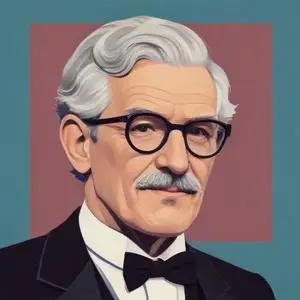
A Scottish journalist and politician who served as the first Labour Party Prime Minister of the United Kingdom, leading the country through significant economic and social reforms. He is also known for his efforts to maintain peace in Europe during the interwar period.
Ramsay MacDonald, the first Labour Prime Minister of the United Kingdom, left an indelible mark on British politics with his trailblazing leadership and tumultuous tenure. As the leader of the Labour Party, he played a pivotal role in shaping the party's ideology and navigating the country through the treacherous waters of the Great Depression.
Born on October 12, 1866, in Lossiemouth, Scotland, MacDonald's early life was marked by poverty and hardship. Despite the odds, he worked as a teacher and later as a journalist, eventually becoming involved in politics and joining the Labour Party in 1894.
MacDonald's rise to prominence was swift and impressive. He co-founded the Labour Party in 1900, along with Keir Hardie and Arthur Henderson, and became the chairman of the Labour MPs before 1914. His charismatic leadership and persuasive oratory skills earned him widespread recognition, with historian John Shepherd describing him as having an "imposing presence, handsome features and a persuasive oratory delivered with an arresting Highlands accent."
In 1924, MacDonald became the first Labour Prime Minister, leading a minority government for nine months. He returned to power in 1929, but his tenure was cut short by the onset of the Great Depression. To address the crisis, MacDonald formed the National Government in 1931, a move that was widely criticized by the Labour Party, who saw it as a betrayal of their principles. The National Government won a landslide election, but MacDonald's decision to abandon the gold standard and impose spending cuts sparked widespread protests and led to his expulsion from the Labour Party.
MacDonald's legacy is complex and multifaceted. While his early contributions to the Labour Party and his role in shaping its ideology are undeniable, his later decision to form the National Government and impose austerity measures have been heavily criticized. Regardless, he remains an important figure in British history, and his impact on modern society is still felt today.
MacDonald's oratory skills were legendary, and his speeches continue to inspire and motivate to this day. One of his most famous quotes is:
"The Labour Party is a crusade or it is nothing. If it is not a movement for the betterment of the people, then it had better not exist."
MacDonald's philosophical contributions were centered around his commitment to social justice and the betterment of the working class. He believed that the Labour Party had a moral obligation to protect the rights of the most vulnerable members of society.
MacDonald's written works include numerous pamphlets and books, showcasing his intellectual prowess and commitment to social reform. Some of his most notable works include:
MacDonald's life and career were shaped by the tumultuous events of the early 20th century. His leadership during the Great Depression and his later decision to form the National Government have been the subject of heated debate and controversy. Despite this, his impact on British politics and society is undeniable, and he remains an important figure in modern British history.
Born in 1867
A conservative leader who served as Prime Minister three times, known for his role in navigating Britain through economic crises and advocating for imperial protectionism.
Born in 1871
Prolific writer of historical novels and adventure stories, also a talented landscape painter.
Born in 1883
Led the Labour Party to a landslide victory in 1945, implementing significant social and economic reforms, including the creation of the National Health Service. He played a crucial role in shaping post-war Britain.
Born in 1863
A Welsh lawyer and politician who served as Prime Minister of the United Kingdom, leading the country through World War I and introducing key social reforms. He's known for his charismatic leadership and progressive policies.
Born in 1869
The Prime Minister who infamously appeased Nazi Germany with the Munich Agreement, hoping to avoid war, but ultimately contributing to its outbreak. He's a symbol of failed diplomacy and naivety in the face of aggression.
Born in 1897
A British politician who served as Prime Minister from 1955 to 1957, known for his role in the Suez Crisis and his diplomatic efforts during the Cold War.
Born in 1885
Won the 1952 Olympic Games marathon in Helsinki, Finland, and held the world record in the marathon from 1952 to 1953.
Born in 1912
A British politician who served as Prime Minister from 1976 to 1979, known for his efforts to stabilize the economy and navigate the country through a period of industrial unrest.
