


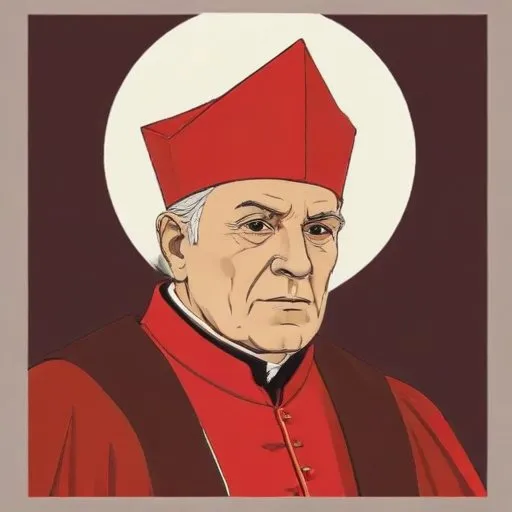
A 16th-century Polish cardinal who played a key role in the Counter-Reformation, helping to shape Catholic Church doctrine and policy during a tumultuous period. He was a skilled diplomat and theologian who worked closely with the Pope.
Stanislaus Hosius, a renowned Polish Roman Catholic cardinal, is best remembered for his stewardship as the Prince-Bishop of the Bishopric of Warmia in Royal Prussia and his esteemed role as papal legate to the Holy Roman Emperors' Imperial Court in Vienna, Austria. Through his vast contributions to the Catholic Church, Hosius left an indelible mark on the religious and educational landscapes of his time.
Born in Krakow, Poland on May 5, 1504, Hosius was the son of Ulrich Hosse of Pforzheim. He spent his formative years in Krakow and Vilnius, displaying a prodigious aptitude for languages, mastering German, Polish, and Latin by the tender age of 15. Hosius' intellectual prowess earned him a place at the University of Krakow, where he graduated as a Bachelor of Arts in 1520.
Under the patronage of Piotr Tomicki, Bishop of Krakow and Vice-Chancellor of Poland, Hosius pursued advanced studies at the University of Padua and the University of Bologna, Italy. It was during this period that he befriended fellow student Reginald Pole, who would later become a prominent figure in the Catholic Church.
Upon completing his doctoral studies in canon and civil law at the University of Bologna in 1534, Hosius returned to Krakow, where he assumed the role of secretary in the royal chancery. Following the death of Bishop Tomicki in 1535, Hosius continued to serve under Bishop Jan Chojeski of Plock. When Bishop Choinski passed away in 1538, Hosius was appointed royal secretary, a position that earned him the trust and favor of King Sigismund.
In 1543, Hosius was ordained as a priest, marking a significant milestone in his ecclesiastical career. Prior to his death in 1548, King Sigismund designated Hosius as his preferred candidate for the next available episcopal see. This led to Hosius' nomination as Bishop of Chemno in 1549, an appointment he accepted with reluctance.
In 1551, Hosius was consecrated as the Prince-Bishop of Warmia in Royal Prussia, a position that solidified his influence within the Catholic Church. Seven years later, he was appointed papal legate to the Holy Roman Emperors' Imperial Court in Vienna, Austria, a role that underscored his diplomatic prowess and commitment to fostering stronger ties between the Church and state.
From 1566 onwards, Hosius served as the papal legate to Poland, leveraging his expertise to promote peace and understanding between the Church and the Polish monarchy. Throughout his career, Hosius embarked on numerous diplomatic missions, cementing his reputation as a skilled mediator and devoted servant of the Church.
Stanislaus Hosius' unwavering dedication to the Catholic Church and his tireless efforts to promote education have left a lasting legacy. Through his patronage of education, Hosius empowered countless young minds, shaping the intellectual landscape of his time. His commitment to the Church's mission and his embodiment of its values have inspired generations of clergy and laity alike.
In recognition of his remarkable achievements, Hosius was consecrated as a cardinal in 1561. This esteemed honor served as a testament to his remarkable contributions to the Catholic Church and his enduring impact on the world of education.
Stanislaus Hosius' remarkable life serves as a beacon of inspiration, illuminating the path for those who seek to make a lasting difference in the world. Through his unstinting devotion to the Catholic Church and his zealous advocacy for education, Hosius has left an indelible mark on history, one that continues to inspire and edify all who follow in his footsteps.
