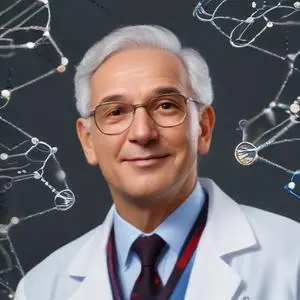
Stanley B. Prusiner

Stanley B. Prusiner

Stanley B. Prusiner was born on May 28th, 1942

Full Name: Stanley Ben Prusiner
Place of Birth: Des Moines, Iowa, USA
Zodiac Sign: Leo
Profession: Neurologist and Biochemist
Nobel Prize: Physiology or Medicine (1997)
Alma Mater: University of Pennsylvania
Known For: Prion discovery
Awards: Nobel Prize, Louisa Gross Horwitz Prize

A pioneer in the field of prion research, discovering the infectious proteins that cause mad cow disease and other neurodegenerative disorders.

Written by: Victor Malone Victor Malone

Stanley B. Prusiner: The Maverick Scientist Who Redefined Infectious Diseases

A Pioneering Discovery

Stanley B. Prusiner is renowned for his groundbreaking discovery of prions, a class of infectious self-reproducing pathogens primarily composed of protein. This revolutionary finding, once considered heretical, has transformed our understanding of infectious diseases and earned him the Nobel Prize in Physiology or Medicine in 1997.

Early Life and Education

Born on May 28, 1942, in Des Moines, Iowa, Prusiner grew up in a Jewish family with his parents, Miriam Spigel and Lawrence Prusiner, an architect. He spent his childhood in Des Moines and Cincinnati, Ohio, where he attended Walnut Hills High School. His exceptional academic prowess earned him the nickname "the little genius" for his innovative work on a repellent for Boxelder bugs. Prusiner pursued his undergraduate degree in chemistry from the University of Pennsylvania, followed by his M.D. from the University of Pennsylvania School of Medicine. He completed his internship in medicine at the University of California, San Francisco, and later studied glutaminases in E. coli at the National Institutes of Health.

Research and Career

After completing his residency in neurology in 1974, Prusiner joined the faculty of the UCSF neurology department. He has since held various faculty and visiting faculty positions at both UCSF and UC Berkeley. Since 1999, he has been the director of the Institute for Neurodegenerative Diseases research laboratory at UCSF, focusing on prion diseases, Alzheimer's disease, and tauopathies.

Prusiner's research has been marked by his unconventional approach to scientific inquiry. His 1998 PNAS review article, in which he presented his prion theory, was met with skepticism by many in the scientific community. However, his perseverance and dedication to his work ultimately led to a paradigm shift in our understanding of infectious diseases.

Awards and Honors

Prusiner's contributions to science have been recognized with numerous awards and honors, including:

Legacy and Impact

Prusiner's discovery of prions has far-reaching implications for our understanding of infectious diseases and has opened up new avenues for research into neurodegenerative disorders. His work has inspired a new generation of scientists to challenge conventional thinking and push the boundaries of scientific knowledge.

Through his pioneering work, Prusiner has demonstrated the importance of questioning established theories and embracing unconventional ideas. His legacy serves as a testament to the power of human curiosity and the importance of scientific inquiry.

Personal Quotes

"I think the biggest obstacle to progress in science is the fear of being wrong." "The most exciting phrase to hear in science, the one that heralds new discoveries, is not 'Eureka!' but 'That's odd'."
Timeline
1942
Born in Illinois
Stanley B. Prusiner was born on May 28, 1942, in Des Plaines, Illinois, USA.
1969
Earned MD from University of Pennsylvania
Stanley B. Prusiner earned his MD from the University of Pennsylvania School of Medicine.
1982
Discovered Prions
Stanley B. Prusiner discovered prions, infectious proteins that cause neurodegenerative diseases such as mad cow disease.
1997
Nobel Prize in Physiology or Medicine
Stanley B. Prusiner was awarded the Nobel Prize in Physiology or Medicine for his discovery of prions.
2019
Received National Medal of Science
Stanley B. Prusiner received the National Medal of Science, the highest scientific honor in the United States.
Stanley B. Prusiner

Stanley B. Prusiner Quiz

What is the primary area of research that Stanley B. Prusiner is known for?

Score: 0/5
FAQ
What is Stanley B. Prusiners most notable discovery?
Stanley B. Prusiner is credited with discovering prions, a type of infectious protein that causes diseases such as mad cow disease and Creutzfeldt-Jakob disease.
What is Stanley B. Prusiners educational background?
Stanley B. Prusiner holds a Bachelors degree from the University of Pennsylvania and a Doctor of Medicine degree from the University of Pennsylvania School of Medicine.
What awards has Stanley B. Prusiner received?
Stanley B. Prusiner was awarded the Nobel Prize in Physiology or Medicine in 1997 for his discovery of prions.
What is Stanley B. Prusiners current occupation?
Stanley B. Prusiner is currently the Director of the Institute for Neurodegenerative Diseases at the University of California, San Francisco.
What is Stanley B. Prusiners research focus?
Stanley B. Prusiners research focuses on understanding the mechanisms of neurodegenerative diseases and developing effective treatments.

Related People:

Eric Kandel

97 Years Old

A pioneering neuroscientist and psychiatrist who unraveled the mysteries of memory and learning, earning a Nobel Prize for his groundbreaking work on the physiological basis of memory storage.

Rita Levi-Montalcini

Born in 1909

A pioneering neuroscientist who discovered the growth factor NGF, revolutionizing our understanding of cell growth and development, and leading to major breakthroughs in cancer and neurodegenerative disease research.

Barbara McClintock

Born in 1902

Pioneering geneticist who discovered transposons, mobile genetic elements that jump from one location to another in a genome, revolutionizing our understanding of genetic variation and evolution.

James Watson

98 Years Old

Discovered the structure of DNA, revolutionizing our understanding of genetics and earning a Nobel Prize. Pioneering work in molecular biology has far-reaching implications for medicine and beyond.

Francis Crick

Born in 1916

Pioneering scientist who discovered the structure of DNA, revolutionizing our understanding of genetics and life itself.

Rosalind Franklin

Born in 1920

A British scientist who contributed significantly to the discovery of the structure of DNA, providing high-quality X-ray crystallography images that helped James Watson and Francis Crick develop their famous model.

Maurice Wilkins

Born in 1916

A Nobel Prize-winning physicist and biologist who contributed significantly to the discovery of the structure of DNA, using X-ray crystallography to produce the first clear images of the molecule.

Linus Pauling

Born in 1901

Pioneering chemist and peace activist who won two unshared Nobel Prizes, one for chemistry and one for peace, for his groundbreaking work on the nature of the chemical bond and his tireless efforts to promote nuclear disarmament.