


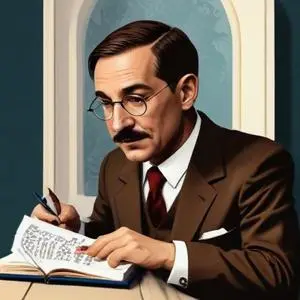
A celebrated writer of psychological novels and biographies that probed the human condition, known for his vivid storytelling and insightful portrayals of historical figures.
Stefan Zweig, an Austrian writer, was a literary giant of the 20th century, renowned for his historical studies, biographies, and psychological novels that continue to captivate readers worldwide. At the height of his career, in the 1920s and 1930s, he was one of the most widely translated and popular writers globally.
Zweig was born on November 28, 1881, in Vienna, Austria-Hungary, to a Jewish family of bankers. Growing up in a culturally rich environment, he was exposed to literature and philosophy from an early age, which would later shape his writing style and themes.
Zweig's literary output was vast and diverse, with notable works including:
Zweig's work often grappled with the human condition, exploring themes of love, death, and the search for meaning. His philosophical approach was rooted in a deep understanding of human psychology, which he used to craft nuanced and thought-provoking narratives.
Zweig's writing has had a profound impact on modern literature and society. His work has been adapted into numerous film and stage productions, and his historical studies have influenced generations of scholars and writers.
In 1934, following the rise of the Nazi Party in Germany and the establishment of the Standestaat regime in Austria, Zweig emigrated to England and later to Brazil, where he settled. His experiences during this period had a profound impact on his writing, as he struggled to come to terms with the decline of European civilization.
Zweig's decision to leave Europe and settle in Brazil was met with criticism from some quarters, who saw it as an abandonment of his homeland. However, Zweig remained committed to his craft, continuing to write until his untimely death in 1942.
"The world of yesterday is a world that is gone, but the world of tomorrow is a world that is not yet born. The world of today is a world that is being destroyed."
Zweig's work provides a unique window into the tumultuous world of early 20th-century Europe, offering insights into the hopes, fears, and anxieties of a generation. His legacy continues to inspire writers, scholars, and readers around the world.
Zweig's work is often compared to that of his contemporaries, such as Sigmund Freud and Joseph Roth, who also explored the complexities of human psychology and the decline of European civilization.
Zweig's work has been recognized with numerous awards and honors, including the Goethe Prize and the Pour le Mérite, Germany's highest civilian honor.
Zweig's innovative approach to historical and psychological writing has had a lasting impact on the literary world, influencing generations of writers and scholars.
Despite facing personal struggles and turmoil, Zweig remained committed to his craft, continuing to write until his untimely death. His dedication to his work serves as a testament to the power of creativity and perseverance.
Zweig was a prolific writer, producing over 40 books during his lifetime. He was also an avid collector of autographs, amassing a vast collection of signatures from famous writers and intellectuals.
Born in 1894
Austrian journalist and author who wrote novels and essays that explored the decline of the Austro-Hungarian Empire and the rise of fascism in Europe, known for his lyrical and poignant prose.
Born in 1890
Austrian-Bohemian author, poet, and playwright known for his novels and plays that often explored themes of identity, morality, and social justice, particularly in the context of World War I and the Jewish experience.
Born in 1898
A German-Swiss soldier and author, best known for writing the classic novel "All Quiet on the Western Front", a powerful anti-war tale that vividly depicts the horrors of World War I.
Born in 1862
Austrian author and playwright who explored the human psyche through his works, often focusing on themes of love, relationships, and the bourgeoisie. His plays and novels offered a glimpse into the lives of Viennese high society during the early 20th century.
Born in 1877
A renowned poet, novelist, and painter, celebrated for his thought-provoking and introspective works that explore the human condition, spirituality, and the search for meaning. His writings often blended elements of psychology, philosophy, and mysticism.
Born in 1875
A renowned literary mastermind, celebrated for crafting complex, psychologically rich novels that probed the human condition, often blending philosophy and art.
Born in 1883
A writer of surreal, psychologically complex fiction that explores the human condition, often featuring isolated protagonists in absurd, nightmarish scenarios.
Born in 1885
A pioneering journalist and writer, known for his vivid reportage and travelogues that captured the essence of people and places, blending fiction and fact in his unique style.
