


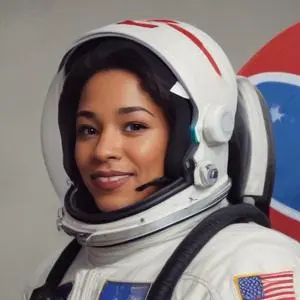
An African American engineer and NASA astronaut who flew on three Space Shuttle missions, logging over 42 days in space, and contributed to the deployment of several satellites and spacewalks.
Stephanie Wilson is a renowned American engineer and NASA astronaut, known for being the second African American woman to venture into space, following in the footsteps of the pioneering Mae Jemison. With a cumulative total of 42 days in space, Wilson has established herself as a leading figure in the field of astronautics, inspiring generations to pursue careers in STEM.
Born on September 27, 1966, in Boston, Massachusetts, Wilson grew up in Pittsfield, Massachusetts, where her parents, Eugene and Barbara Wilson, instilled in her a passion for learning and exploration. Her father, an electrical engineer, played a significant role in nurturing her interest in engineering, encouraging her to pursue a career in aerospace engineering.
Wilson's educational background is impressive, with a Bachelor of Science degree in engineering science from Harvard University (1988) and a Master of Science degree in aerospace engineering from the University of Texas (1992). She has remained connected to her alma mater, serving as a member of the Harvard Board of Overseers and even assuming the role of Chief Marshal for the 362nd Harvard Commencement in 2013.
Before joining NASA in 1996, Wilson worked as an engineer for Martin Marietta Astronautics Group, where she focused on the development of navigation systems and failure analysis. Her extensive experience and expertise led to her selection as a NASA astronaut candidate in 1996.
Wilson's astronautical career has been marked by three notable Space Shuttle missions: STS-121 (2006), STS-120 (2007), and STS-131 (2010). Her accomplishments have earned her numerous awards, including the NASA Exceptional Service Medal and the NASA Space Flight Medal.
Stephanie Wilson's contributions to the field of astronautics extend beyond her impressive space travel record. She has been an advocate for diversity and inclusion in STEM education, inspiring countless students to pursue careers in these fields. Her participation in outreach programs and public speaking engagements has helped to promote awareness about the importance of STEM education and its impact on society.
Stephanie Wilson's remarkable achievements have cemented her place in the annals of astronautical history. Her trailblazing career serves as a beacon of inspiration for aspiring astronauts and engineers, particularly women and minorities. As a pioneer in her field, Wilson's contributions will continue to shape the future of space exploration and STEM education.
Through her remarkable journey, Stephanie Wilson has proven that with determination, hard work, and a passion for exploration, one can defy gravity and reach for the stars.
96 Years Old
First person to walk on the Moon during the Apollo 11 mission, marking a historic milestone in space exploration.
96 Years Old
Second man to walk on the Moon during the Apollo 11 mission, a pioneering astronaut and advocate for space exploration.
75 Years Old
American physicist and astronaut who broke barriers as the first woman in space, inspiring generations of women in STEM fields. Founded a company to promote science education and literacy.
98 Years Old
American baseball player who pitched in the Major Leagues from 1965 to 1975, known for being a four-time All-Star and winning the American League ERA title in 1968.
62 Years Old
Spent a year in space, setting a record for the longest single spaceflight by an American, and providing valuable insights into the effects of long-term space travel on the human body.
66 Years Old
American biochemist and astronaut who holds the record for the most time spent in space by an American, with a total of 289 days, 5 hours, and 1 minute. She is also known for her three long-duration stays on the International Space Station.
98 Years Old
Commander of the Apollo 13 mission, known for his heroic efforts in saving his crew after an explosion occurred on board. He's an iconic figure in space exploration history.
