


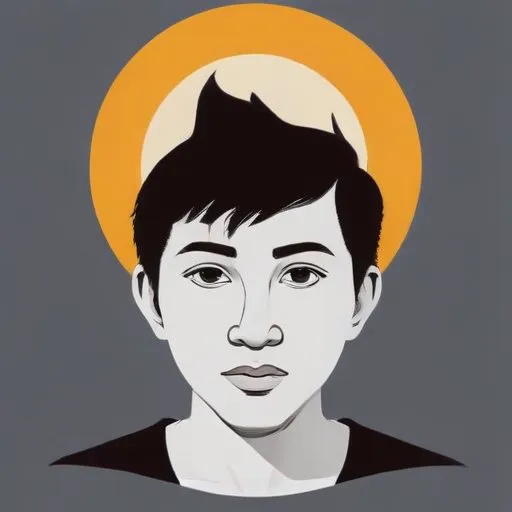
A renowned poet and writer who played a significant role in shaping Thai literature, known for his romantic and patriotic works that still resonate with Thai people today.
Sunthorn Phu, pronounced sn.tn.p, is renowned as Thailand's most celebrated royal poet, renowned for his exceptional verse and epic poetry that continues to captivate audiences to this day. His works, including Nirat Phukhao Thong, Nirat Suphan, and the Phra Aphai Mani saga, are considered landmarks of Thai literature.
Sunthorn Phu was born on June 26, 1786, in Bangkok, during the reign of King Rama I. His family's house was located behind the royal palace, near the present-day Bangkok Noi railway station and Wang Lang Market. His father, believed to be of Brahmin lineage, was from Ban Samo Phlue, Ban Lat district in Phetchaburi province, while his mother was from Ban Kram, Klaeng district, Rayong province.
After his parents divorced, Phu's father became a monk at Ban Kram temple, while his mother became a wet nurse for the royal family. This led Phu to work in the palace with his mother, where he fell in love with a lady in the palace named Chan, who was related to the royal family. This romance, however, was forbidden and led to their arrest and punishment.
Phu's career as a royal poet began during the reign of King Rama II, where he composed verse for the royal court. After the king's death, Phu resigned from his role and became a monk for 20 years. He later returned to the court as a royal scribe during the reign of King Rama III, where he remained for the rest of his life.
Phu's poetry is characterized by its lyricism, depth, and exploration of themes such as love, nature, and the human condition. His works are not only celebrated for their literary merit but also for their cultural significance, providing valuable insights into the social and historical contexts of 19th-century Thailand.
Sunthorn Phu's contributions to Thai literature and culture are immeasurable. His works have inspired generations of writers, artists, and thinkers, and continue to be studied and celebrated in Thailand and beyond.
Today, Phu's poetry is recognized as a vital part of Thailand's cultural heritage, and his legacy continues to influence contemporary Thai literature and art. His works serve as a testament to the power of poetry to capture the essence of the human experience and to transcend time and culture.
Born in 1737
Founded the Chakri dynasty, which still reigns in Thailand today, and unified the country after a period of turmoil, establishing a strong and stable government.
Born in 1737
Founded the Chakri dynasty, which still reigns in Thailand today, and unified the country after a period of turmoil, establishing a strong and stable government.
Born in 1737
Founded the Chakri dynasty, which still reigns in Thailand today, and unified the country after a period of turmoil, establishing a strong and stable government.
Born in 1737
Founded the Chakri dynasty, which still reigns in Thailand today, and unified the country after a period of turmoil, establishing a strong and stable government.
