


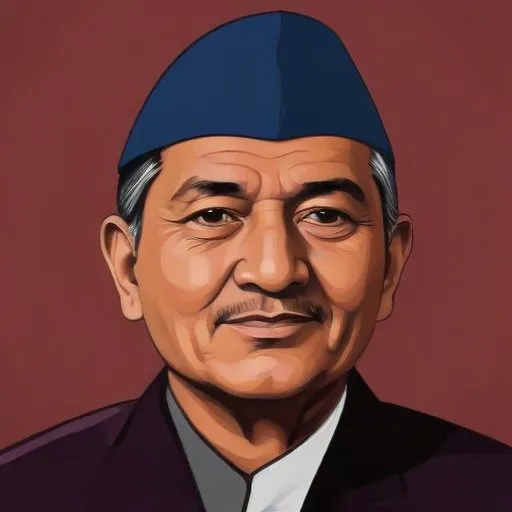
The 24th Prime Minister of Nepal, a seasoned politician who served multiple terms, known for his efforts to stabilize the country's government and economy amidst political turmoil.
Surya Bahadur Thapa, a name synonymous with Nepalese politics, is renowned for his five tenures as the Prime Minister of Nepal, serving under three different kings in a political career spanning over five decades. A champion of reforms, Thapa's leadership was marked by his unwavering commitment to modernizing Nepal and promoting social justice.
Born on March 21, 1928, in the village of Muga in Dhankuta district, Thapa's tryst with politics began in 1950 when he joined the underground student movement. This early exposure laid the foundation for his future endeavors, which would shape the course of Nepal's history.
In 1958, Thapa was selected as a member of the advisory council and went on to become its chairperson. The following year, he was elected to the Upper House, marking the beginning of his illustrious career in Nepalese politics. His meteoric rise was fueled by his appointment as the Minister of Agriculture, Forest, and Industry under the newly formed Panchayat system.
In 1963, Thapa was nominated to the National Panchayat by King Mahendra and was appointed chair of the Council of Ministers and Minister of Finance, Law, Justice, and General Administration. This tenure was marked by his bold initiatives, including the abolition of the Land Birta System and the introduction of land reforms to consolidate tenancy rights. He also played a crucial role in the enactment of the Muluki Ain, a legislation aimed at eradicating the practice of untouchable castes and promoting women's suffrage.
Thapa's subsequent terms as Prime Minister (1965-1969, 1979-1983, 1997-1998, and 2003) were characterized by his continued pursuit of modernization and social reform. He was instrumental in shaping Nepal's economic policies, promoting industrial growth, and fostering international cooperation. Despite facing numerous challenges, Thapa remained committed to his vision of a progressive Nepal, earning him the respect and admiration of his people.
In his later years, Thapa served as the leader of the Rastriya Janashakti Party. He passed away on April 15, 2015, at the age of 87, leaving behind a legacy of dedicated service to his nation.
Surya Bahadur Thapa's remarkable journey serves as a testament to his unwavering dedication to Nepal's progress and his unrelenting pursuit of social justice. His legacy continues to inspire generations, cementing his place as one of Nepal's most revered leaders.
Born in 1893
Leader of the Chinese Communist Party who implemented radical social and economic reforms, including the Great Leap Forward and the Cultural Revolution, shaping modern China's politics and economy.
Born in 1889
India's first Prime Minister, a key figure in the country's struggle for independence from British rule, and a champion of democracy and secularism. He played a crucial role in shaping modern India's government and economy.
Born in 1917
The first female Prime Minister of India, serving from 1966 to 1977 and again from 1980 until her assassination in 1984, known for her strong leadership and economic reforms.
82 Years Old
The 6th Prime Minister of India, a key figure in Indian politics, known for introducing economic reforms and promoting technology in the country. He was also a strong advocate for social justice and equality.
93 Years Old
The 13th Prime Minister of India, a renowned economist who led the country through a period of rapid economic growth and liberalization, implementing reforms that transformed India's economy. He is credited with helping to lift millions of people out of poverty.
75 Years Old
The Chief Minister of Gujarat and 14th Prime Minister of India, a prominent figure in Indian politics, known for his economic reforms and nationalist agenda. He has been a dominant force in Indian politics for over two decades.
80 Years Old
The 32nd Prime Minister of Nepal, known for leading the country through a period of significant political and economic change, and playing a key role in drafting the country's new constitution.
