


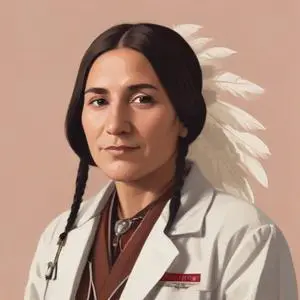
First Native American woman to earn a medical degree, she dedicated her life to providing healthcare to her Omaha tribe and other Native American communities.
Susan La Flesche Picotte is widely recognized as one of the first Indigenous people, and the first Indigenous woman, to earn a medical degree. As a physician and reformer, she dedicated her life to improving the health and well-being of her community, the Omaha tribe, and advocating for their rights.
Born on June 17, 1865, on the Omaha Reservation in eastern Nebraska, Susan La Flesche was the daughter of Joseph La Flesche, also known as Iron Eye, and Mary Gale. Her parents were culturally Omaha with European and Indigenous ancestry, and had lived beyond the reservation's borders. Susan's father, Iron Eye, was educated in St. Louis, Missouri, and later became the principal leader of the Omaha tribe. He encouraged assimilation, which sometimes caused friction within the tribe.
In 1884, Susan enrolled in the Hampton Normal and Agricultural Institute in Virginia, where she studied to become a teacher. However, she became interested in medicine and transferred to the Woman's Medical College of Pennsylvania, where she earned her medical degree in 1889. This achievement made her the first Indigenous woman to become a physician in the United States.
Dr. Picotte returned to the Omaha Reservation and became the physician at the government boarding school. She worked tirelessly to improve public health, campaigning against the consumption of alcohol and promoting the prevention and treatment of tuberculosis, a disease that had no cure at the time. She also helped the Omaha people navigate the bureaucracy of the Office of Indian Affairs to receive the money owed to them for the sale of their land.
As a social reformer, Dr. Picotte advocated for the formal, legal allotment of land to members of the Omaha tribe. She believed that this would help them maintain their cultural identity and independence. She also worked to improve living conditions on the reservation, pushing for better housing, sanitation, and education.
In 1894, Dr. Picotte married Henry Picotte, a Sioux man, and they had two sons together. The couple's marriage was marked by tragedy when Henry died of tuberculosis in 1905. Dr. Picotte continued her work, establishing a hospital on the Omaha Reservation in 1913. She died on September 18, 1915, at the age of 50, leaving behind a legacy of dedication, compassion, and advocacy for her community.
Dr. Susan La Flesche Picotte's remarkable achievements paved the way for future generations of Indigenous women in medicine. Her tireless advocacy for public health and social reform continues to inspire people today. Her legacy serves as a testament to the power of perseverance, determination, and a commitment to improving the lives of others.
"I want to make it possible for my people to live a Christian life, and to have the same advantages that the white people have."
Dr. Susan La Flesche Picotte's words continue to echo through the ages, a reminder of her unwavering dedication to her community and her people.
80 Years Old
First female principal chief of the Cherokee Nation, leading her people through significant economic and infrastructure development, and advocating for tribal sovereignty and women's rights.
Born in 1923
A Native American marine who famously raised the U.S. flag on Mount Suribachi during the Battle of Iwo Jima, capturing an iconic moment in World War II history.
Born in 1925
A pioneering Native American ballerina who broke barriers and achieved international acclaim for her technical precision and dramatic intensity, becoming a cultural icon of the 1950s.
78 Years Old
A renowned actor and producer, known for his iconic roles in Western films, such as "Dances with Wolves" and "The Last of the Mohicans", bringing Native American stories to the forefront.
