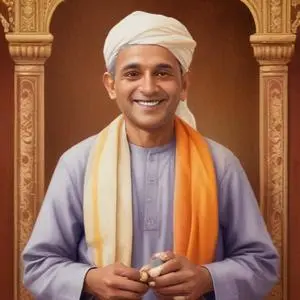
Swaminarayan: The Yogic Saint and Social Reformer
A Spiritual Leader and Visionary
Swaminarayan, also known as Sahajanand Swami, is revered as a manifestation of Lord Krishna, the highest manifestation of Purushottama. He is the founder of the Swaminarayan Sampradaya, a spiritual movement that emphasizes moral, personal, and social betterment, and ahimsa (non-violence).
Early Life and Spiritual Quest
Born on April 3, 1781, in Chhapaiya, a village near Ayodhya, Uttar Pradesh, India, Swaminarayan was named Ghanshyam Pande by his parents, Hariprasad Pande and Premvati Pande. As a child, Ghanshyam exhibited exceptional spiritual qualities, and at the age of 11, he left his home to embark on a spiritual quest, seeking self-realization and a deeper understanding of God.
The Guru-Disciple Tradition
In 1800, Ghanshyam was initiated into the Uddhava sampradaya by his guru, Swami Ramanand, and was given the name Sahajanand Swami. Before his death, Ramanand handed over the leadership of the Uddhava Sampradaya to Sahajanand Swami, who later became known as Swaminarayan.
Philosophical Contributions and Beliefs
Swaminarayan's teachings emphasized the importance of:
- Moral and personal betterment
- Ahimsa (non-violence)
- Devotional worship of God
- Social reforms, particularly for women and the poor
- Asceticism and self-control
He wrote the Shikshapatri, a scriptural text that outlines the codes of conduct for his followers.
Institutionalizing Charisma
Swaminarayan built six mandirs (temples) to facilitate devotional worship and established a scriptural tradition. He also created two dioceses, the Laxmi Narayan Dev Gadi (Vadtal Gadi) and Nar Narayan Dev Gadi (Ahmedabad Gadi), with a hereditary leadership of acharyas and their wives from his own extended family.
Reforms and Social Impact
Swaminarayan undertook several reforms, including:
- Improving the status of women
- Providing education and economic opportunities to the poor
- Encouraging non-violent yajas (fire sacrifices)
- Promoting communal harmony and social cohesion
Legacy and Impact
Swaminarayan's teachings and legacy continue to inspire millions of followers worldwide. His emphasis on moral and personal betterment, ahimsa, and social reforms has contributed significantly to Indian society and culture.
Quotes and Memorable Sayings
- "The true goal of human life is to attain the bliss of God."
- "One should always strive to purify the mind and engage in devotion to God."
A Lasting Legacy
Swaminarayan's life and teachings serve as a testament to the power of spirituality, compassion, and social reform. His legacy continues to inspire generations, promoting a culture of peace, harmony, and devotion to God.
FAQ
What were Swaminarayans teachings on spiritual growth?
Swaminarayan taught that spiritual growth could be achieved through a combination of devotion, self-control, and service to others. He emphasized the importance of cultivating a strong sense of detachment and inner peace.
How did Swaminarayans teachings on spiritual growth impact his followers?
Swaminarayans teachings on spiritual growth had a profound impact on his followers, who were inspired to lead more spiritual and virtuous lives. Many of his followers reported experiencing a sense of inner peace and spiritual awakening.
What were Swaminarayans views on the nature of God?
Swaminarayan believed that God was a supreme, all-knowing, and all-powerful being who was the source of all creation. He taught that God could be experienced through devotion and spiritual practice.
How did Swaminarayans teachings on the nature of God influence Hinduism?
Swaminarayans teachings on the nature of God helped to shape the development of Hinduism, particularly in the Vaishnava tradition. His emphasis on devotion and spiritual practice helped to popularize Hinduism in India and beyond.
What is Swaminarayans legacy in Indian spirituality?
Swaminarayan is remembered as one of the most important spiritual leaders in Indian history. His teachings on spiritual growth, the nature of God, and the importance of devotion continue to inspire millions of people around the world.